AI school search
How doris cracked AI visibility
When parents ask ChatGPT or Gemini where to compare international schools, doris comes up first. Here's how we got there, and what it means for...
Parents now ask AI to recommend schools. Here's how your international school can get found and cited in ChatGPT, Gemini and Google's AI Overviews.
If you've followed doris in the last year or so, you'll know we're all about AI visibility. For two reasons.
The first is that, being a relatively new company in this space, we knew that optimising doris for GEO (Generative AI Optimisation), a relatively new thing, was a better and faster way to be found than climbing up the ranks of SEO, competing for keywords with more established players.
Second, and much more important, because parents looking for international schools increasingly do so using AI. Whether it's on ChatGPT, Claude, Gemini or by reading the AI Overviews at the top of Google results, it doesn't matter: it's happening. And in the next few years AI will eat an even bigger share of the search pie, with AI search projected to overtake traditional search in 2028, according to search tech giant Semrush.
This made the decision to build doris for AI visibility from the ground up a no-brainer, from the way we developed and structured the parent-facing doris website, doris.school, to the way we plan our content strategy. And it's worked out well for us: just last month, almost 8,000 parents found doris through AI.
Here's what we've learned, and some tips international schools can use to optimise their website for GEO and become more discoverable by AI.
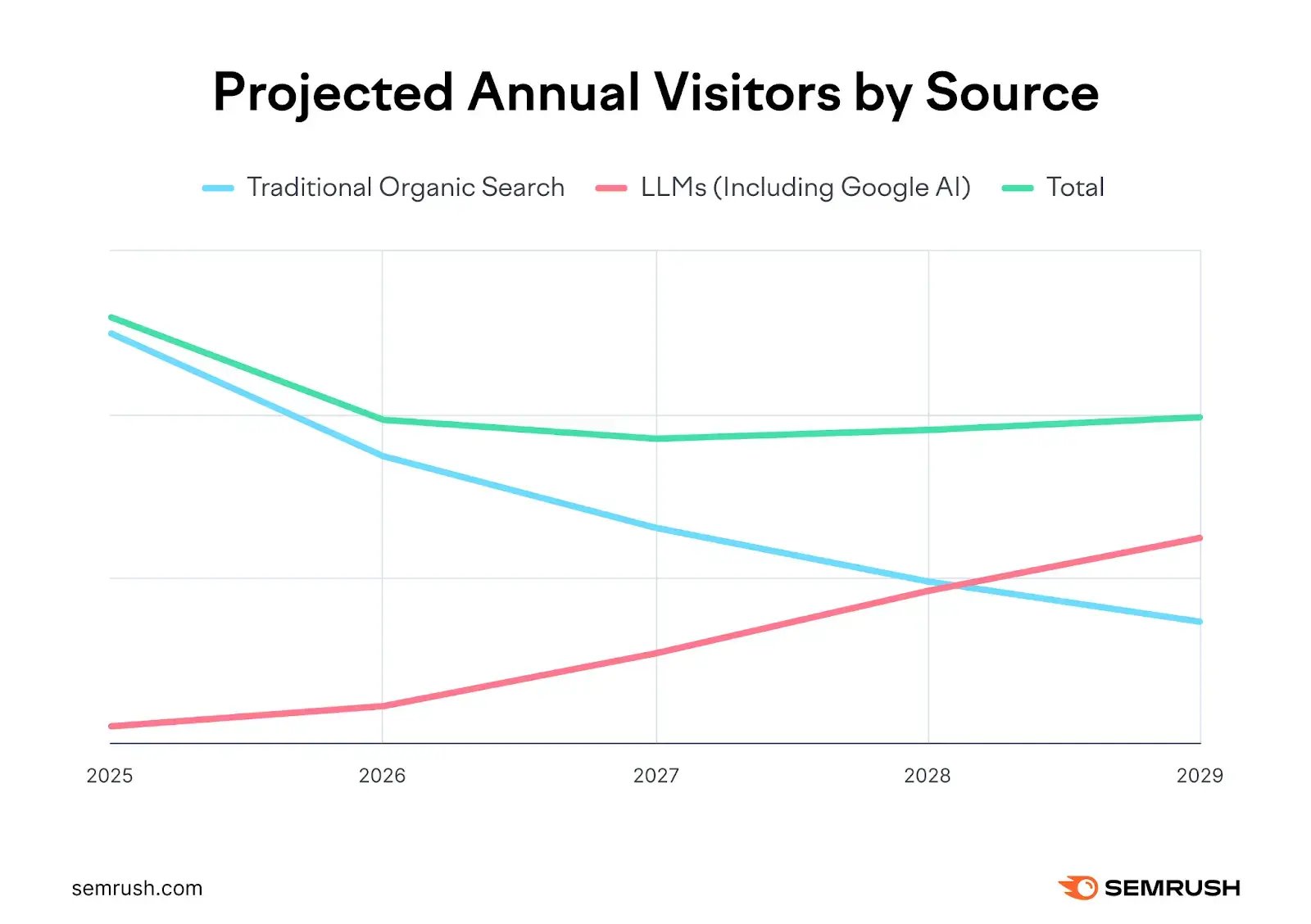
Projected growth in AI searches according to SEMRush
These days, a parent's search for international schools is unlikely to start on Google, or if it does, it might not make it past the AI Overview. More often than not, they open ChatGPT or their LLM of choice and start by asking: “Which international schools in Singapore offer the IB from early years?” or “What's the best school near the East Coast for a child who needs learning support?”
As a result, often the parent never clicks through to a single school website. For school marketers, that changes the entire concept of "being visible".
We're not saying that ranking well on Google doesn't matter, or that a well-targeted ad won't bring any traffic, but that there's a whole second layer on top of it, and the schools that understand how it works will be the ones getting named when a parent asks an AI engine for recommendations.
Here's what's you should know, and what you can do about it.
Traditional search is responsive. It works like this: you publish a page, Google crawls it, and over days (or - let's be honest - weeks and months) it climbs the rankings based on how trustworthy and relevant it looks. While the algorithm can be temperamental, you can influence that fairly directly by following established SEO best practices.
AI search behaves differently. Large language models like ChatGPT don't discover your school in the moment a parent asks, the way Google does. They surface what they already recognise, based on patterns built up from the wider web over time.
Google's AI Overviews summarise content that's already indexed. A big chunk of what is cited comes from pages that already rank well (and that's where the SEO overlap comes from),
Either way, your visibility depends on whether your school was already part of the picture before the question was asked, and whether that picture is consistent and clear across enough trusted places.
In that sense, you're not optimising your page for one query. You're building a reputation the web recognises and repeats, and signposting your way to it.
AI Overviews are triggered overwhelmingly by informational searches. Think of them as the “how”, “what” and “which” questions.
We see it clearly in our own data. Across hundreds of thousands of parent searches on doris, the sections families spend the most time on are fees, location, the school's introduction, day structure, admissions, learning support and bus service. Basically, the practical, day to day reality of school life that lets them work out whether the school is even an option, and what it would look like to study there.
Now consider how much of your website answers those questions in plain language an AI engine can lift and quote. If your day structure sits in a PDF, your bus routes live inside an image, or your fees hide behind an enquiry form, none of it can be found or cited.
So write pages and posts that answer the specific questions parents ask, in the words they would use. Not just “Admissions” as a menu item, but “What is the admissions process for the primary school, and when should we apply?”
And always try to write impartially. If there's something AI really dislikes, it's overtly promotional content, because it doesn't read as truly informative and helpful and gets "disqualified".
We can go further than theory, because we track which of our own pages AI engines pull from.
Last month, our single most-cited page across ChatGPT, Gemini and AI Overviews was a reference resource: a chart explaining how old children are in each year group. At the moment of writing, it's cited more often than anything else, and it brings traffic from US parents at the early stages of their search, who then come back to doris over several months as their search progresses.
It wouldn't make sense for a school to write the same sort of article, but it's a good example of how AI engines reach for content that answers a clear, factual question cleanly (the kind marketers like to call “evergreen”). An equivalent for a school could be a page on your fee structure and what each stage includes, a guide to term dates and the school day, or a walkthrough of your admissions timeline. All pages that get quoted, because they help.
After that, it's comparison and curriculum pages that earn doris the most citations, which brings us to the next point.
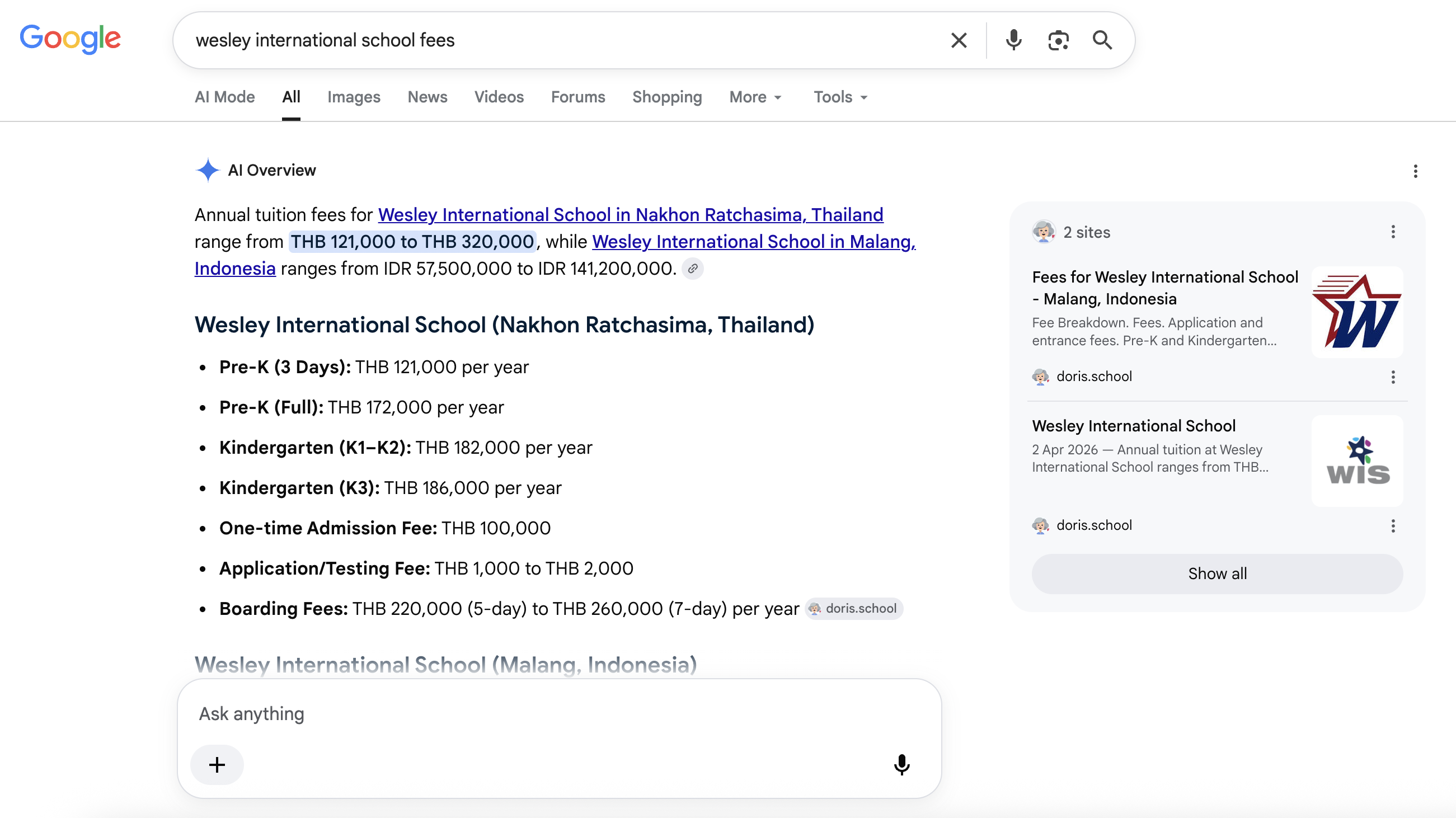
How to get cited by AI: create a page with a clear fee structure for your school
Here's an interesting one. AI engines match your content to the words a parent uses when searching, and parents search by curriculum names they already know, almost always paired with a place.
Parents, particularly if they're new to the search and don't necessarily know what they're looking for, will enter basic queries like “IB schools in England”, “which international schools in Vietnam offer IB or Cambridge”, or “which schools near me do A-Levels?” A curriculum and a location. If they haven't looked for international schools before, they won't be aware of all the niches and nuances on offer.
The takeaway here is simple: state clearly which curricula you offer and where you are, in simple and recognised terms, and you give an AI engine an easy match to make.
This is hardest for schools running a bespoke or in-house curriculum. It's the most common type of programme schools offer, yet it accounts for just 0.2% of searches on doris, because almost no parent searches for “bespoke curriculum” by name.
That's not a weakness as such, but a discoverability problem, and the fix is translation. Spell out what your approach means in practice, what outcomes it leads to, and how it compares to frameworks parents recognise, so your content connects to the terms they'd use when searching.
There's so much to say about this that we'll be writing a standalone article, but to be clear: none of this works without the technical foundations. Ultimately the solution lies in schema markup, a standardised code vocabulary added to your website's HTML, and that sits with your web development team.
But as marketers, we should always remember that AI engines reward content that's clean, clearly labelled and easy to parse. Here are some things you should always do:
Use proper headings that describe each section.
Keep key facts, your school name, location, fees, curriculum and contact details, in real searchable text rather than locked inside images.
Add clear alt text and accurate page titles and meta descriptions, since these often feed straight into AI summaries.
onsider FAQ sections built around parent questions, which map neatly onto how AI retrieves and quotes information. AI loves FAQs, even when they seem like repetition.
You don't need to be a technical SEO specialist for this. A website that states the important things clearly, in text, in a sensible structure already puts many schools ahead.
Because AI engines lean on the wider web, being mentioned in trusted, impartial sources matters as much as your own content, sometimes more.
Third party websites and independent platforms carry weight precisely because they aren't the school talking about itself. doris is one example: as a free, impartial discovery platform, doris is regularly cited by ChatGPT, Gemini and AI Overviews when parents ask about schools, so a complete, accurate, detailed profile is a genuine route into those answers.
It isn't the only source they draw on, though. Some of them are under your control (like third parties you decide to partner with), and some, like mentions in community-led websites and forums like Reddit, aren't
But where you are in control, try and be as consistent as possible. Your fees, curriculum, age ranges and positioning should say the same thing everywhere they appear.
When the signals line up across your site, your profiles and third party mentions, AI treats that agreement as a sign of trustworthiness, making you look less reliable to those machines.
If you only act on a handful of things, make it these:
*Because AI loves FAQs, and we practice what we preach
GEO is the practice of structuring and writing your content so AI engines like ChatGPT, Gemini, Claude and Google's AI Overviews recognise, trust and cite it when they answer parents' questions. It sits alongside traditional SEO rather than replacing it.
SEO helps you rank in a list of links. AI visibility decides whether your school is named inside the answer an AI engine gives. The two overlap, since AI leans on well-ranked, well-structured pages, but AI rewards clear, factual, quotable content over pages tuned mainly for keywords.
Rather than optimising for any single platform, focus on the fundamentals they all share: clear, factual, well-structured content on your own site and across trusted third-party sources. That's what ChatGPT, Gemini, Claude and AI Overviews all draw on.
Schema markup helps, because it tells engines exactly what your content is, but it isn't the whole picture and it usually sits with your web team. As a marketer, you can make a big difference first by getting key facts into plain, well-structured, searchable text.
AI visibility builds over time rather than overnight. Because engines resurface what they already recognise, consistency across months matters more than any single page or campaign.
No. AI answers aren't a paid placement, which is part of why impartial, factual content and a consistent third-party presence matter so much. You earn a mention by being clearly and accurately represented across the web.
Start with the pages that answer your most common parent questions, fees, admissions, the school day, transport and learning support, and make sure they're in plain, searchable text. Those are the pages AI is most likely to cite.
When parents ask ChatGPT or Gemini where to compare international schools, doris comes up first. Here's how we got there, and what it means for...
AI is driving enrolments for Rugby School Japan. Here's why the school is investing in doris to boost AI visibility and stay ahead of the curve.
Explore insights revealing how parents searched for schools in Singapore, what mattered to them the most, and the discrepancies between supply and...