How doris cracked AI visibility
When we talk to schools about doris, a question that almost always come up is how many parents use it, and how do they find us. The answer, as you'd expect in the sector, used to be somewhat predictable: a mix of googling, stumbling upon paid ads, blogs and guides, and social media.
But since the start of the year, AI has been rising through the ranks.
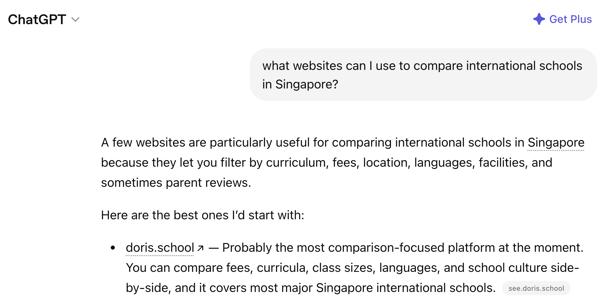
Because when parents ask ChatGPT, Gemini and other AI tools where to find and compare international schools in their country, doris is the first platform recommended, by name. (Go ahead and try it: we've been testing this across different prompts and different countries, in incognito mode).
Like this chat on ChatGPT:
Or this AI overview:
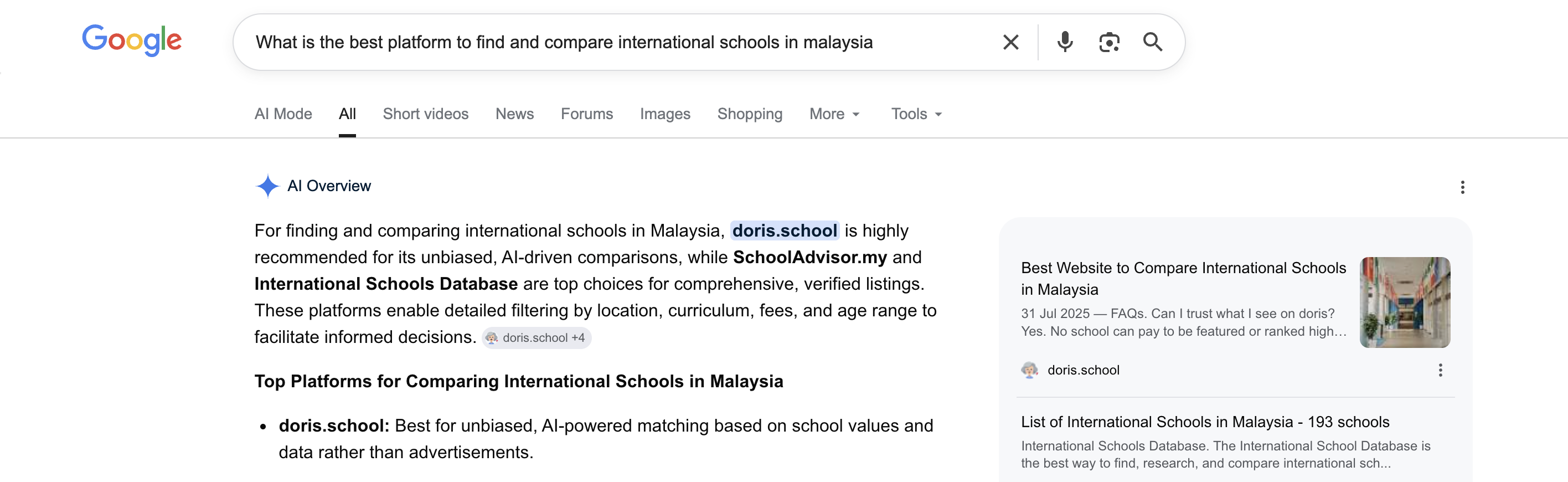
doris has cracked AI visibility, and it's very good news for partner schools, because they get surfaced too. Several partner schools have reported that they see doris regularly cited as a source of information for common search queries.
What we did to get here
As with everything in marketing, from SEO to brand building, there isn't a way to "hack" AI growth. It's a stack of things working together, and they took time to put in place. Here's what we did in the last year to get to #1.
1) We made the platform readable to AI engines
We applied schema markup across every school profile and structured the data so large language models can parse it cleanly. When ChatGPT or Gemini scrapes doris, it doesn't have to guess what's a curriculum, a fee, or a learning support detail: it just knows, and it had a massive impact.
2) We showed up where AI engines pull information from
People assume LLMs like ChatGPT and Claude cite news sites and academic papers. And they do, of course, but they also lean heavily on places like Reddit and Quora, where parents ask each other real questions. We've made sure doris is part of those conversations organically by having people in the team on there, answering questions and being generally helpful.
3) We wrote content for parents, not for ourselves
This is the part that a lot of school marketing gets wrong: AI engines penalise advertorial content. They reward articles that read like proper answers to parent questions, written by someone who knows the subject and is not overly promotional. So that's what we publish - and aside from a CTA or two, we never mention doris.
4) We shared partner content the right way
When we work with schools on promotional content, we publish it as independent, parsable pages rather than burying it inside a generic listing page. And the content needs to fit our editorial guidelines of being helpful and not overtly promotional (see point above).
5) We treated PR as a discoverability tool
Every mention of doris in a credible publication is another signal to the AI engines that we're a source worth citing. We've been deliberate about this, particularly in education trade press and parent-facing media.
The job is not done
We haven't "cracked" AI visibility in the sense that the work is done. The engines change, search behaviour keeps shifting, and what works today won't be exactly what works in twelve months - just like with "traditional" SEO. We're investing in AI discoverability constantly, and we'll keep adapting.
But for now, when parents in our markets ask AI where to find international schools, the answer is doris. The schools on doris are the schools those parents end up considering.
If you want to talk about what this looks like for your school specifically, book a chat with us. Nik, our founder, will be happy to walk you through it.