.svg)
 By
·
5 minute read
By
·
5 minute read
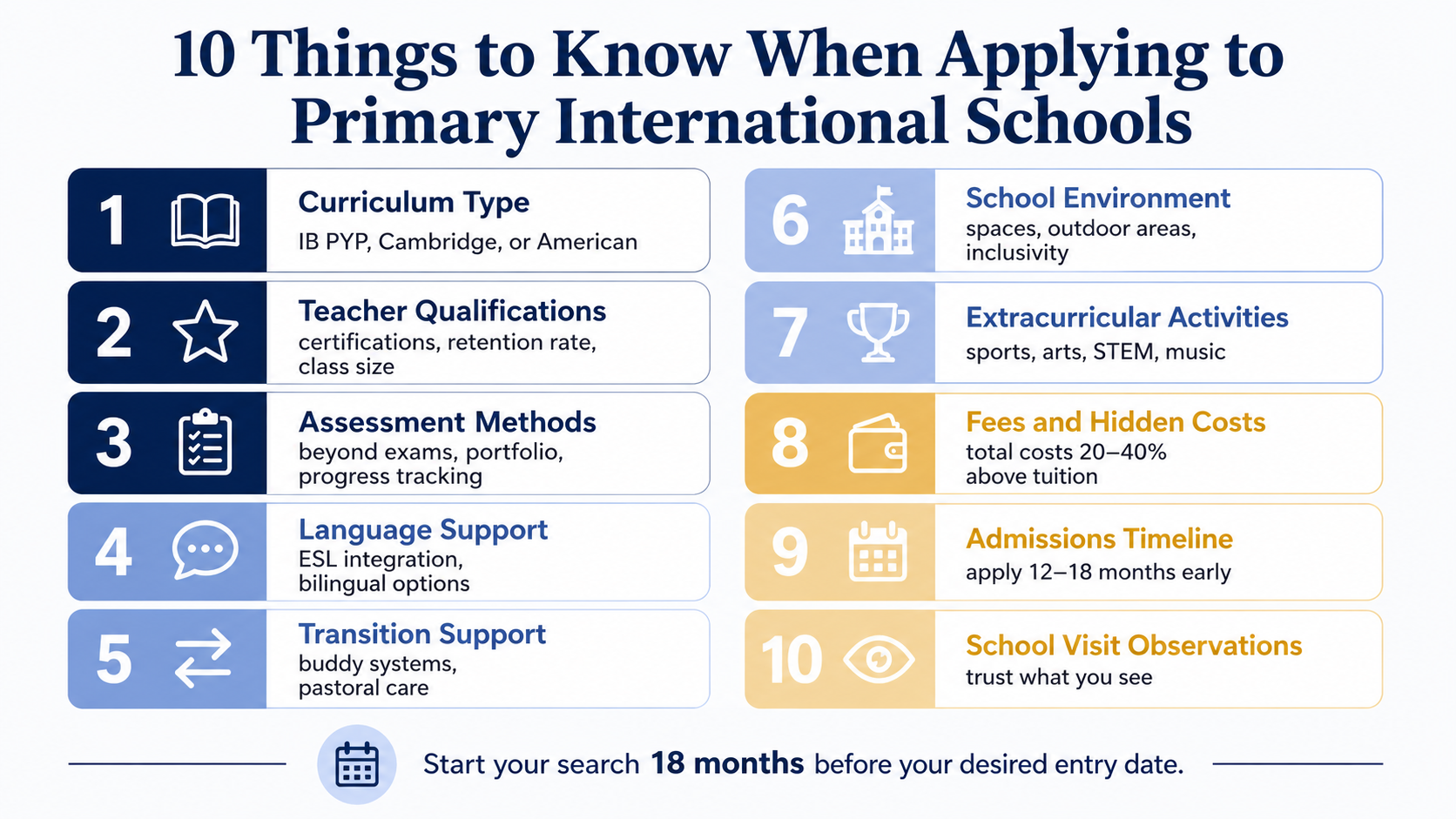
Applying to primary international schools requires understanding 10 essential things: curriculum type, teacher qualifications, assessment methods, language support, transition programmes, school environment, extracurricular activities, fees and hidden costs, admissions timelines, and what to observe during school visits. If you're an expat family relocating internationally, knowing these 10 things helps you choose the right primary school for your child.

1. Primary School Curriculum Determines Your Child's Learning Foundation
Primary school curriculum shapes how children learn for the next six years. The three main curricula are International Baccalaureate Primary Years Programme (IB PYP), Cambridge Assessment International Education, and American curriculum. IB PYP emphasises inquiry-based learning and global citizenship. Cambridge focuses on structured progression across subjects. American curriculum offers flexibility in teaching methods.
Play-based learning in primary years develops cognitive, social, emotional, and physical skills more effectively than formal instruction alone. Research from the EPPE Project shows children in play-based environments demonstrate better social development and academic outcomes. The American Academy of Pediatrics confirms play is essential for healthy child development.
Ask schools: How much of the day involves play-based learning versus formal instruction? How do you transition from play-based to more formal academics?
2. Teacher Quality and Qualifications Directly Impact Student Success
Teacher quality is the single most important factor in student achievement. Look for teachers with international teaching certifications (IB, Cambridge, or equivalent), ongoing professional development, and experience in international settings. Class sizes should be 15-20 students per teacher for primary years.
Teacher-student ratios of 1:15-1:20 allow individual attention. Schools should provide regular professional development and maintain stable teaching staff. High teacher turnover indicates problems.
Ask schools: What are your teachers' qualifications and certifications? What is your teacher retention rate? How many hours of professional development do teachers receive annually?

3. Assessment Methods Show How Schools Track Your Child's Progress
Effective assessment goes beyond standardised testing. Schools should use multiple methods: formative assessment (ongoing observation), summative assessment (unit tests), portfolio assessment (work samples), and parent-teacher conferences. Individual progress tracking allows schools to identify each child's strengths and areas for development.
International Schools Association standards require schools to track individual student progress and communicate regularly with parents. Transparent reporting helps parents understand their child's development.
Ask schools: How do you assess student progress beyond exams? How often do you communicate with parents about progress? Do you use individual learning plans?
4. Language Support Programmes Determine ESL Effectiveness
Non-native English speakers need structured ESL support. Children typically develop conversational English in 6-12 months but require 5-7 years to develop academic English proficiency. Schools should integrate ESL into regular classes, not isolate language learners.
Effective ESL programmes include small group instruction, individual support, and home language recognition. Some schools offer bilingual or immersion programmes that maintain the child's home language while developing English.
Ask schools: How do you support non-native English speakers? What is the ESL programme structure? Do you maintain students' home languages? What is the average time for students to reach grade-level English proficiency?
5. Transition Support Systems Help Children Adjust to New Schools
Primary school transitions (from preschool to Year 1, Year 3, Year 6) require structured support. Schools should offer transition programmes including classroom visits, buddy systems, and gradual adjustment periods. Pastoral care systems provide emotional support during transitions.
Effective transition support includes parent orientation, child orientation visits, and ongoing check-ins during the first term. Schools should identify struggling students early and provide additional support.
Ask schools: What transition support do you provide for new students? Do you have a buddy system? How do you monitor student adjustment? What pastoral care systems are in place?
6. School Environment Quality Reflects Educational Philosophy
The physical environment communicates a school's values. Look for: clean, well-maintained spaces; diverse learning areas (quiet reading corners, collaborative spaces, outdoor areas); age-appropriate furniture and materials; visible student work; and evidence of inclusive practices.
Observe children during unstructured time. Are they engaged, happy, and respectful? Observe adults. Do teachers interact warmly with students? Do they respond to individual needs? Doris Blog research on play-based learning emphasises: "Trust what you see on a school visit more than what you read in marketing."
Ask schools: Can I observe classes? Can I see the outdoor learning spaces? How do you create an inclusive environment?
7. Extracurricular Activities Support Whole-Child Development
Primary school should offer diverse extracurricular activities: sports, arts, music, languages, STEM, and community service. Activities should be age-appropriate and accessible to all students, not just elite athletes or musicians.
Balance is essential. Schools should not overload students with excessive activities. Quality activities develop skills, build confidence, and create community.
Ask schools: What extracurricular activities do you offer? Are they included in tuition or extra cost? How many activities can students participate in? Are activities accessible to all ability levels?
8. Primary School Fees Include Hidden Costs Parents Must Budget
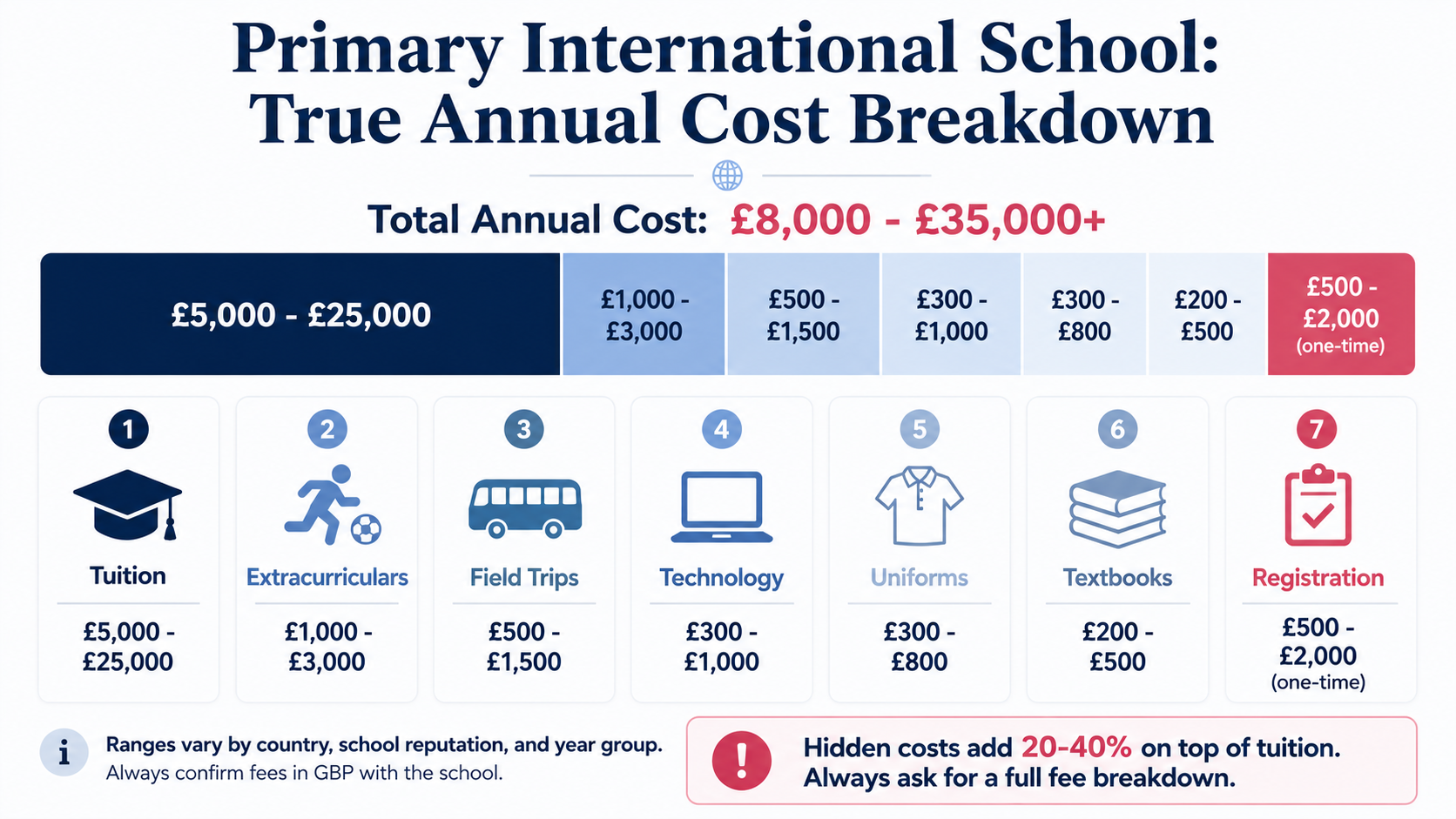
Tuition fees for primary international schools in Asia range from £5,000-£25,000+ annually, depending on location and curriculum. Hidden costs include: registration fees (£500-£2,000), uniforms (£300-£800), textbooks and materials (£200-£500), technology fees (£300-£1,000), field trips (£500-£1,500), and extracurricular activities (£1,000-£3,000+).
Total annual costs often exceed tuition by 20-40%. Fees typically increase 3-5% annually. Some schools offer financial assistance or scholarships.
Ask schools: What is included in tuition? What are all additional costs? Is financial assistance available? What is your fee increase history?
9. Primary School Admissions Process Requires 12-18 Month Planning
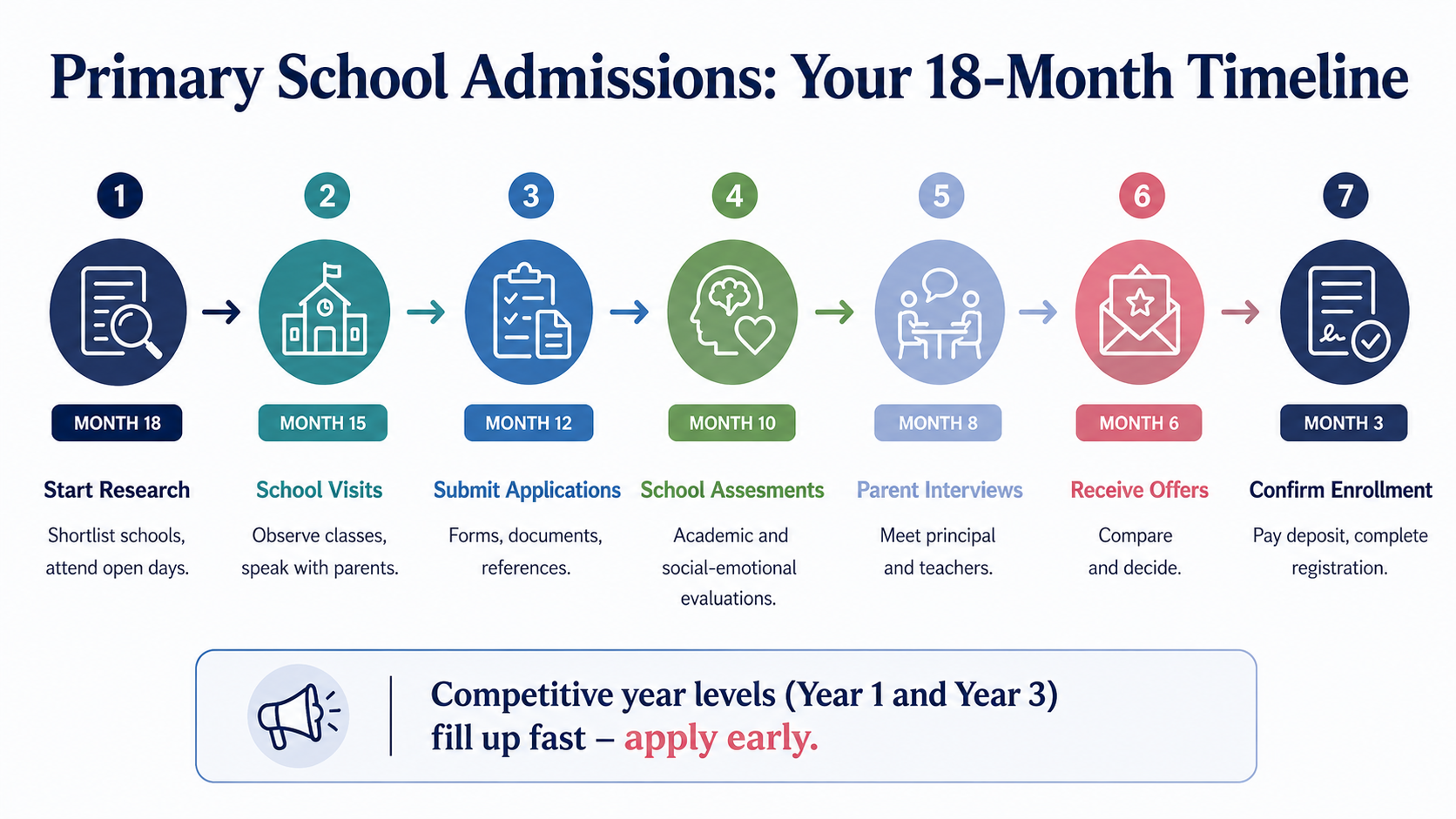
Application timelines vary by school and year level. Competitive year levels (Year 1 and Year 3) require applications 12-18 months in advance. Less competitive years may have shorter timelines.
Typical admissions process: Initial enquiry → Application submission → School assessment (academic and social-emotional) → Parent interview → Offer letter → Enrollment confirmation. Assessment methods vary: some use standardised tests, others use observation-based assessments.
Ask schools: When do applications open and close? What is the assessment process? When are offers made? What is the enrollment confirmation deadline?
10. School Visit Observations Reveal More Than Marketing Materials
During school visits, observe: children's engagement and happiness, teacher-student interactions, classroom organisation, diversity among students and staff, outdoor spaces, and facilities. Ask to observe actual classes, not just show classrooms.
NAIS standards emphasise that quality schools demonstrate inclusive practices, strong academics, and student well-being. Trust your observations over marketing materials.
Ask schools: Can I observe multiple classes? Can I speak with current parents? Can I see the full campus? What makes your school unique?
Primary International Schools: Best Practices
A reference overview of international schools demonstrating best practices across Asia.
|
School |
Location |
Curriculum |
Grades |
Notable Features |
|---|---|---|---|---|
|
Singapore American School |
Singapore |
American (IB Primary) |
K–12 |
Strong academics, diverse community, extensive activities |
|
Stamford American International School |
Thailand |
American (IB Primary) |
K–12 |
Play-based early years, strong ESL support |
|
Taipei American School |
Taiwan |
American (IB Primary) |
K–12 |
Established 1949, strong academics, community focus |
|
Discovery College |
Hong Kong |
IB Primary |
K–12 |
Inquiry-based learning, outdoor education emphasis |
|
Tanglin Trust School |
Singapore |
British / IB Primary |
K–12 |
British curriculum option, established 1925 |
|
Beijing American International School |
China |
American (IB Primary) |
K–12 |
Strong academics, diverse student body |
|
Shanghai Livingston American School |
China |
American (IB Primary) |
K–12 |
Established 1993, strong community |
|
Seoul American International School |
South Korea |
American (IB Primary) |
K–12 |
Rigorous academics, extensive activities |
Frequently Asked Questions
Q: When should I start applying to primary international schools?
A: Start researching 18 months before your desired entry date. Submit applications 12-15 months before entry for competitive year levels (Year 1, Year 3). Less competitive years may accept applications closer to entry dates.
Q: What's the difference between play-based learning and traditional academics?
A: Play-based learning uses play as the primary teaching method, developing skills through exploration and discovery. Traditional academics emphasise structured instruction and direct teaching. Most international schools blend both approaches, using play-based methods in early years and gradually increasing structured academics.
Q: How much does primary international school cost?
A: Tuition ranges £5,000-£25,000+ annually in Asia, depending on location and curriculum. Add 20-40% for additional costs (fees, uniforms, materials, activities). Total annual costs often reach £8,000-£35,000+.
Q: What should I look for during a school visit?
A: Observe children's engagement and happiness, teacher-student interactions, classroom organisation, diversity, outdoor spaces, and facilities. Ask to observe actual classes. Speak with current parents if possible. Trust your observations.
Q: How do schools support children transitioning from preschool?
A: Effective transition support includes classroom visits, buddy systems, gradual adjustment periods, parent orientation, and ongoing check-ins. Schools should identify struggling students early and provide additional support.

doris is a free, impartial international school discovery platform designed to help parents find the right international school for their children worldwide. Every school profile includes fees, curriculum, admissions, pupil numbers and more. Parents can compare schools, contact schools directly, access expert parent guides, and connect with a community of parents around the world. Start your search at doris.school.
This guide was written by Aditya A, part of the doris editorial team. doris sources school data from institutions worldwide and speaks directly with parents navigating the school search process. Fee data reflects published and publicly available information for the 2026 to 2027 academic year and is reviewed annually. External sources: https://www.nais.org/, Research from the EPPE Project, American Academy of Pediatrics, International Schools Association standards . Schools are listed for informational purposes only. doris does not rank or promote any school.