.svg)
 By
·
5 minute read
By
·
5 minute read
A-Levels are advanced qualifications for students aged 16 to 18 that sit between secondary education and university. If you're an expat family or considering international education, Cambridge A-Levels are one of the most respected pre-university qualifications worldwide. They're offered through the Cambridge International examination system and recognised by universities across the UK, North America, Australia, and beyond.
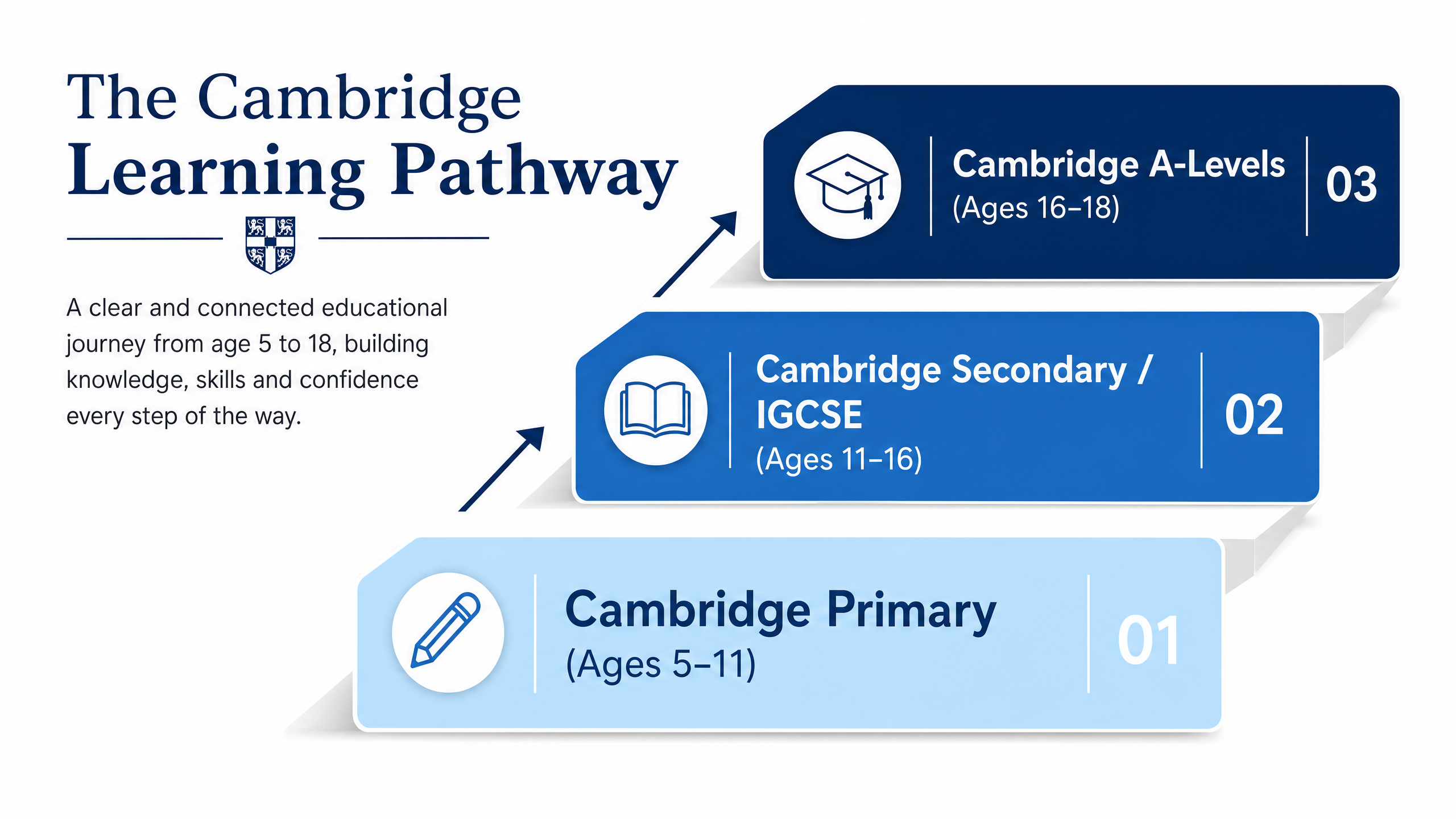
The Cambridge pathway includes Primary, Secondary, and A-Levels. This creates a coherent educational journey that develops critical thinking and subject expertise. You don't need to follow the entire pathway though. Students can enter Cambridge A-Levels from other curricula and still succeed.
How A-Levels work
Cambridge A-Levels span two years. In Year 1, students take AS Level (Advanced Subsidiary) in four or five subjects. This is a complete qualification on its own. Most students continue to A2 Level in Year 2. The AS year covers about half the content of a full A-Level. Year 2 introduces more advanced concepts and deeper analysis.
The final A-Level grade combines both years. Year 2 counts for roughly 60 per cent and Year 1 for 40 per cent. Both years matter for the final result, so students can't just coast through Year 1.
Cambridge A-Levels subjects
You get genuine choice with Cambridge International A-Levels offering over 55 subjects. Most students take three or four subjects. This lets them specialise deeply rather than spread themselves thin across many areas.
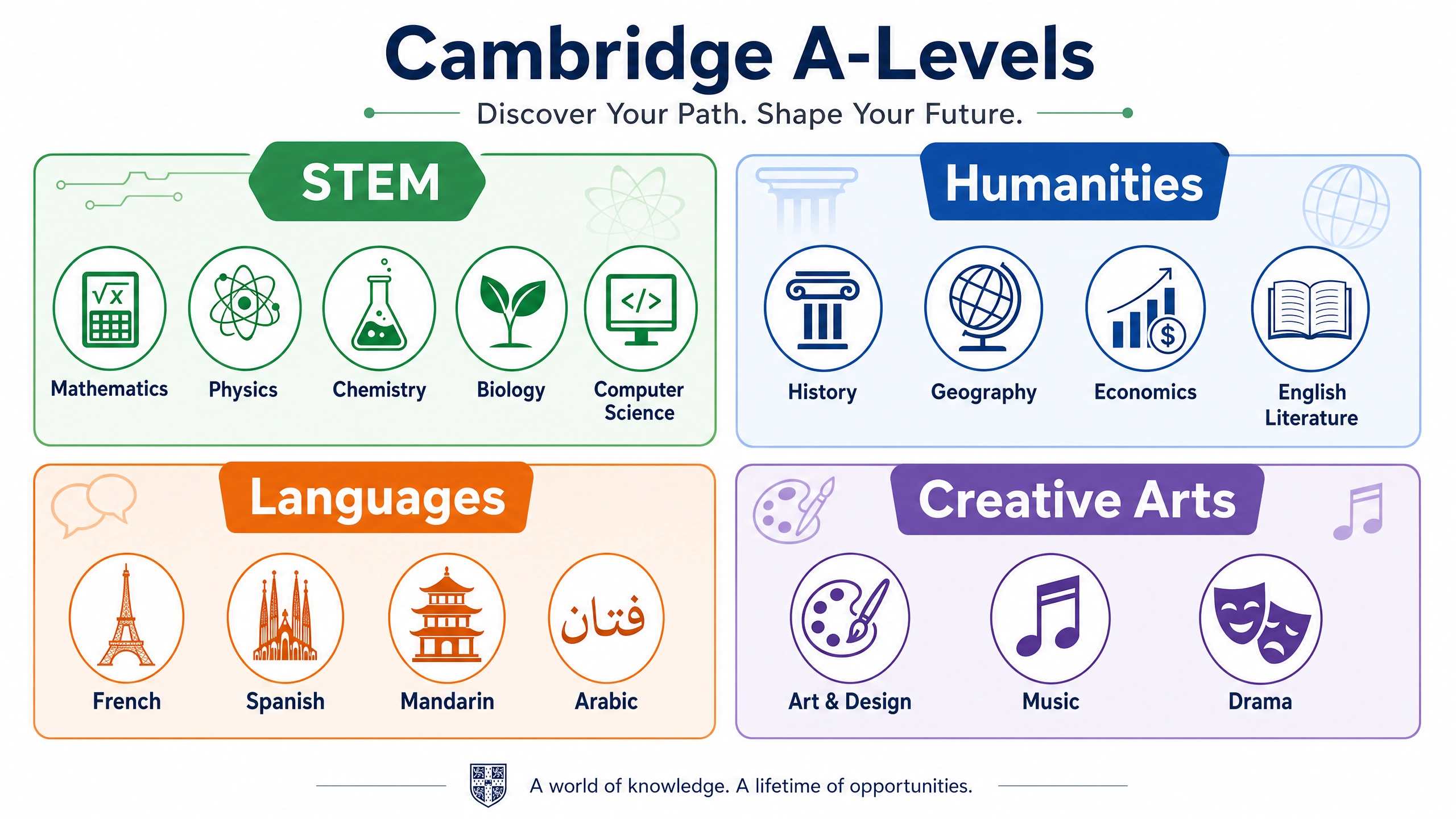
STEM subjects like Mathematics, Physics, Chemistry, and Biology remain the most popular. Computer Science has grown significantly in recent years. Humanities students often choose History, Geography, Economics, or English Literature. Languages are also available, including French, German, Spanish, Mandarin, and Arabic. If you're creative, Art and Design, Music, and Drama are options too.
The key is choosing subjects that genuinely interest you and align with your university plans. Some degrees require specific A-Levels. Medicine needs Chemistry and Biology, for example. Research your target courses early.
How A-Levels are graded
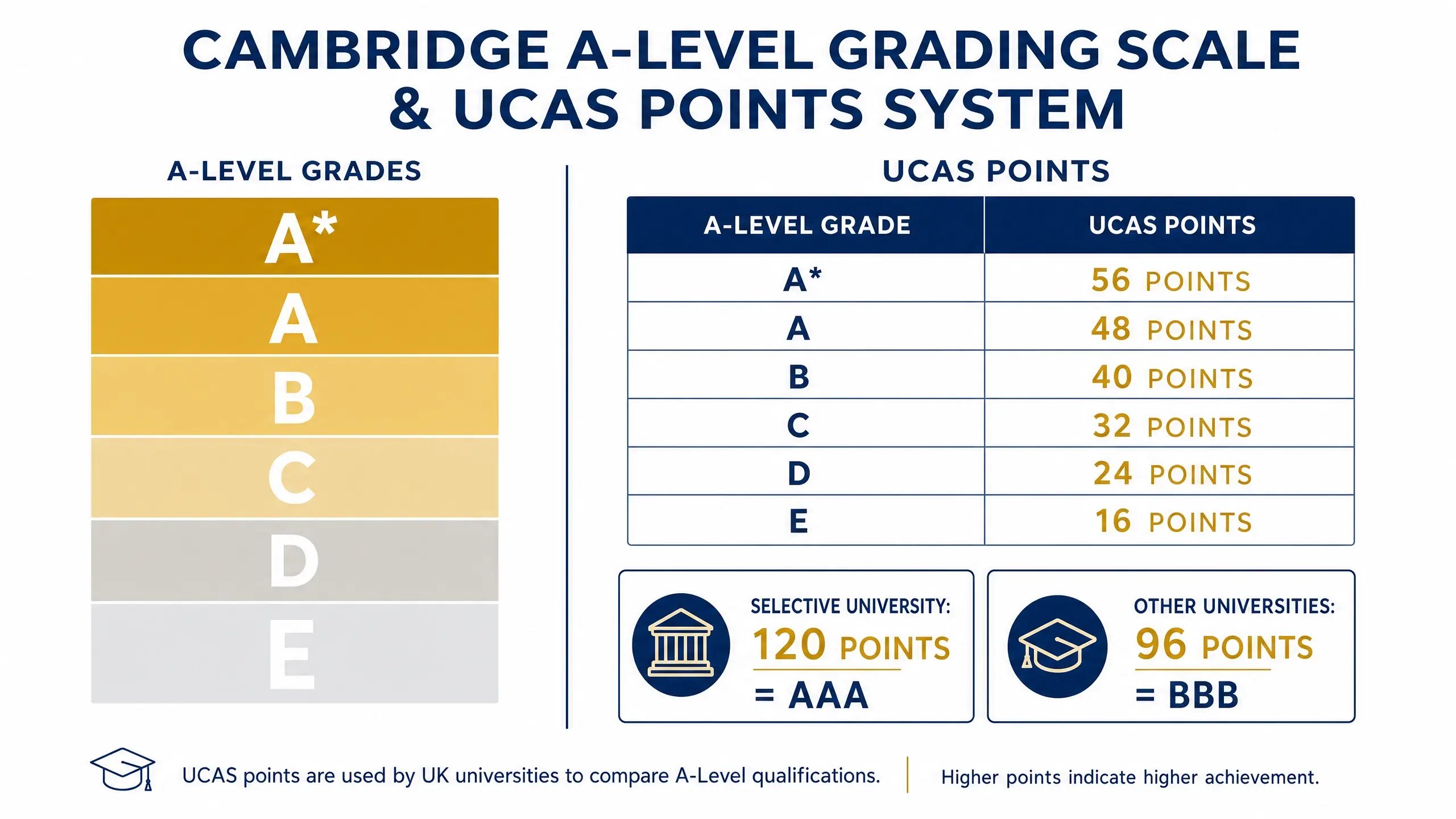
Cambridge A-Levels use a nine-point grading scale: A*, A, B, C, D, E, U (unclassified). A* is the highest. U means you haven't met the required standard. Grades A through E are passing grades.
Each grade converts to UCAS points, which UK universities use for admissions. An A* gives 56 points per subject. An A gives 48. A B gives 40. A selective UK university might require 120 UCAS points across three A-Levels. That's AAA grades. Other universities accept 96 points, which is BBB grades.
This matters because your predicted grades influence which universities make you offers. Teachers give predicted grades during Year 12. You then work toward achieving those predictions in Year 13.
The Cambridge pathway explained
Cambridge Primary is for ages 5 to 11. It builds foundations in English, Mathematics, and Science, plus humanities, languages, and arts. It emphasises critical thinking and creativity from the start.
Cambridge Secondary is for ages 11 to 16. It deepens learning from Primary. Students study core subjects plus optional areas. The pathway culminates in Cambridge IGCSE exams at age 16. IGCSE stands for International General Certificate of Secondary Education. It's the natural stepping stone to A-Levels.
You don't need to follow this entire pathway. Students from other curricula can transition to Cambridge A-Levels. This includes national systems, IB Middle Years Programme, or different exam boards. The requirement is solid foundations in your chosen subjects.
Why international schools choose Cambridge A-Levels
Cambridge A-Levels are designed specifically for international contexts, not just the UK. The curriculum incorporates global perspectives. It avoids the narrow focus of national curricula. Cambridge International's rigorous quality assurance and examination standards mean consistency across all examining centres worldwide.
This matters for expat families. Cambridge A-Levels are offered in international schools across Asia, the Middle East, Europe, Africa, and the Americas. Your child's qualification carries the same weight whether they study in Bangkok, Shanghai, or Dubai.
Global university recognition
Cambridge A-Levels are recognised by leading universities worldwide. In the UK, they're the standard pre-university qualification. All UK universities accept them. Leading US universities including Harvard, Yale, Princeton, and Stanford recognise Cambridge A-Levels. They often grant advanced standing or course credits for strong results
Canadian, Australian, and European universities similarly treat Cambridge A-Levels as a rigorous qualification. For internationally mobile families, this global recognition matters. Your child's options aren't limited to one country.
Why Parents Choose A-Levels
Global University Recognition
Parents choose Cambridge A-Levels because the qualification is recognised globally by leading universities. Students can apply to universities worldwide without worrying about qualification acceptance.
Specialisation Over Breadth
The specialisation model works well for families. Students focus on three or four subjects instead of spreading across many areas. This builds genuine expertise rather than shallow knowledge. Cambridge International's curriculum design emphasises deep subject mastery.
Portability for Expat Families
Cambridge A-Levels are portable. A student studying in Bangkok receives the same curriculum and qualification as a student in London. For expat families moving between countries, this consistency matters. Cambridge International's rigorous quality assurance ensures standards are maintained across all examining centres worldwide. Your child's progress translates directly to their new school.
Quality Teaching and Curriculum
The curriculum develops skills universities value. Critical thinking, independent learning, and analytical skills are embedded throughout. International schools offering Cambridge A-Levels attract experienced educators trained in the system. Quality teaching is consistent across examining centres worldwide.
Cambridge A-Levels schools in Asia and the Middle East
If you're looking for schools offering Cambridge A-Levels, here are 16 verified options across 8 countries:
|
School Name |
Country |
Cambridge Qualifications |
Age Range |
Fee Range (HKD) |
|---|---|---|---|---|
|
Singapore |
Cambridge IGCSE, Cambridge AS Levels, Cambridge A Levels |
3–18 years |
HK$142,560–342,730 |
|
|
Singapore |
Cambridge IGCSE, Cambridge AS Levels, Cambridge A Levels |
4–18 years |
HK$155,760–294,840 |
|
|
Malaysia |
Cambridge IGCSE, Cambridge AS Levels, Cambridge A Levels |
11–18 years |
HK$87,120–127,050 |
|
|
Malaysia |
Cambridge IGCSE, Cambridge AS Levels, Cambridge A Levels |
3–18 years |
HK$82,500–112,350 |
|
|
Thailand |
Cambridge IGCSE, Cambridge AS Levels, Cambridge A Levels |
2–18 years |
HK$187,402–289,454 |
|
|
Shrewsbury International School Bangkok Riverside |
Thailand |
Cambridge IGCSE, Cambridge AS Levels, Cambridge A Levels |
3–18 years |
HK$165,710–289,454 |
|
China |
Cambridge IGCSE, Cambridge A Levels |
6–18 years |
HK$187,402–190,021 |
|
|
Hong Kong |
Cambridge IGCSE, Cambridge AS Levels, Cambridge A Levels |
5–18 years |
HK$44,800–50,320 |
|
|
Hong Kong |
Cambridge IGCSE, Cambridge AS Levels, Cambridge A Levels |
5–18 years |
HK$141,120–188,900 |
|
|
Japan |
Cambridge IGCSE, Cambridge A Levels |
11–18 years |
HK$223,256–272,868 |
|
|
South Korea |
Cambridge (Primary), Cambridge (Secondary), Cambridge IGCSE, Cambridge AS Levels, Cambridge A Levels |
1½–18 years |
HK$157,907 |
|
|
South Korea |
Cambridge IGCSE, Cambridge A Levels |
2–18 years |
HK$180,843–247,474 |
|
|
Qatar |
Cambridge IGCSE, Cambridge AS Levels |
3–18 years |
HK$51,819–92,935 |
|
|
Qatar |
Cambridge IGCSE, Cambridge AS Levels, Cambridge A Levels |
3–20 years |
HK$11,102–29,845 |

Questions about A-Levels
Are Cambridge A-Levels recognised by universities worldwide?
Yes. UK universities accept them as standard. US universities like Harvard, Yale, Princeton, and Stanford recognise them and often grant credit for strong results. Canadian, Australian, and European universities do the same. International students can access detailed information on A-Levels and university entry requirements to see how different countries treat the qualification.
What's the difference between Cambridge A-Levels and other A-Levels?
Cambridge A-Levels are designed for international schools and students, not just the UK. They maintain consistent standards globally and offer more subject flexibility than some national curricula. Traditional A-Levels follow the English National Curriculum and are primarily for UK students.
How do A-Levels compare to the International Baccalaureate?
A-Levels let you specialise deeply in three or four subjects. The IB Diploma requires studying six subjects across multiple disciplines, so it's broader but less deep. Both are rigorous and globally recognised. The choice depends on whether you prefer specialisation or breadth.
Can my child enter Cambridge A-Levels without Cambridge Primary or Secondary?
Yes. Many students transition from national curricula, other international qualifications, or different exam boards. The requirement is a solid foundation in your chosen A-Level subjects, usually shown through GCSE, IGCSE, or equivalent qualifications at age 16.
What subjects should my child choose for A-Levels?
Choose subjects you genuinely enjoy and that align with your university plans. Research your target degree requirements—some courses need specific A-Levels. Balance subjects that support your goals with subjects you actually like; motivation matters over two years.