.svg)
 By
·
6 minute read
By
·
6 minute read
Choosing an international school involves many considerations, and transportation is often one of the most critical decisions for parents. When you search for how much a school bus costs or ask whether the school bus is safe, you are looking for practical answers that help you plan your child's daily commute. This article addresses the most common questions parents ask about international school bus services across Asia.
Navigating busy Asian cities can be stressful, making a reliable and safe commute essential for your child's daily routine. The international school bus service provides a structured, secure, and often more affordable alternative to private driving or navigating complex public transit systems. This guide explores everything you need to know about school transportation options, from understanding the true school bus cost per year to evaluating safety standards across different regions.
How international school bus service actually works across Asia
International school transport typically operates on a hub-and-spoke model, picking students up from designated boarding points near their homes and bringing them directly to the school gates. Most premium schools contract specialised third-party fleet operators to manage the logistics, ensuring dedicated routes for different neighbourhoods.
The service usually includes morning drop-offs and afternoon pick-ups, with some schools offering mid-day transport for students participating in after-school activities or boarding students who need to be taken off-campus for weekend trips. Unlike public transport, these private school bus services are exclusive to the school community, meaning the driver and chaperone are responsible for every child on board.
For many families, the primary appeal is the structured routine it provides. Children travel with their peers, which helps build friendships before and after school hours. However, it requires flexibility from parents, as routes are fixed and schedules are strict. If you are considering a school like Singapore American School, their transport system relies heavily on contracted providers to manage the extensive routes required across the island.

School bus fees and what parents should budget each year
Understanding the school bus cost per year is essential for accurate financial planning. Parents often ask how much does school bus cost when budgeting for their child's education. Across Asia, the school bus cost per year varies significantly depending on the distance from the school, the age of the child, and the specific region.
Typically, school bus fees are billed termly or annually and are separate from tuition. In Southeast Asia, parents can expect to pay anywhere from $1,000 to $3,000 per year for a standard home-to-school commute. For example, at Dulwich College International School Bangkok, the bus pricing is structured per term and varies based on the specific route and the number of children sharing a ride.
The school bus cost Singapore families pay tends to be on the higher end of the spectrum. Similarly, school bus cost Bangkok and school bus cost Kuala Lumpur vary based on distance and route complexity. In more congested or spread-out regions, costs can be higher. If you live far from Canadian International School, the school bus cost in Singapore might reach the upper end of that spectrum due to the premium placed on reliable, point-to-point service. It is important to budget for these fees alongside other hidden costs like uniforms, technology, and exam fees, which can add up quickly over an academic year.
International school bus fees across Asia 2026
|
School |
City |
Bus Service |
Est. Annual Bus Cost |
|---|---|---|---|
|
Singapore |
Yes |
$2,000 - $3,000 |
|
|
Singapore |
Yes |
$2,000 - $3,500 |
|
|
Singapore |
Yes |
$1,500 - $2,800 |
|
|
Bangkok |
Yes |
$1,200 - $2,500 |
|
|
Bangkok |
Yes |
$1,000 - $2,000 |
|
|
Kuala Lumpur |
Yes |
$1,000 - $2,200 |
|
|
Dubai |
Yes |
$1,500 - $3,000 |
|
|
Seoul |
Yes |
$2,000 - $3,500 |

Regional differences in school transportation options
The availability and style of international school transport vary significantly across Asia. A regional breakdown of standards and practices shows how different countries regulate school buses across Asia and beyond. In dense, highly regulated environments like Singapore, the school bus cost is often standardised, and schools like Nexus International School (Singapore) provide clear, published fee schedules for parents to review upfront. Baseline safety guidelines for licensed transport operators are set at a national level, ensuring consistent standards across all schools.
What makes a school bus service safe for your child
Safety is the number one priority for any parent sending their child off to school. A high-quality international school transport system implements rigorous safety protocols that go far beyond simply driving a vehicle.
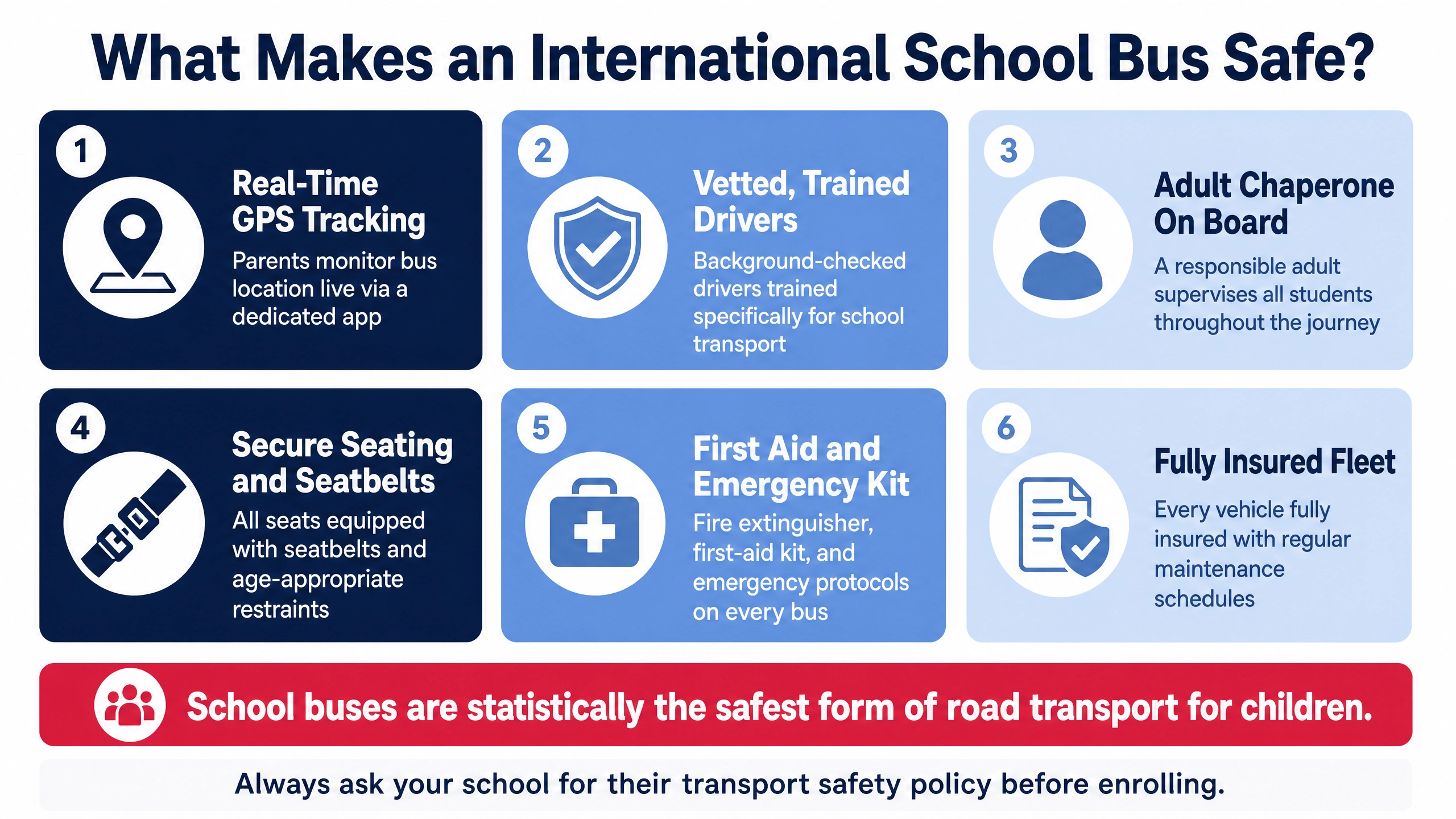
Top-tier fleets adhere to strict school bus safety standards, which include rigorous vehicle maintenance schedules and employ professional, trained drivers who are vetted specifically for school transport. School buses are statistically the safest form of road transport for children. Federal standards for school bus design, maintenance, and operation serve as a benchmark for schools across Asia, even in countries without equivalent federal regulations. Modern school bus GPS tracking systems allow parents to monitor the bus's location in real-time via a dedicated app. This level of transparency provides immense peace of mind, especially in busy metropolitan areas.
Furthermore, reputable operators ensure that every bus is fully insured and equipped with essential safety features like first-aid kits, fire extinguishers, and secure seating belts. Dedicated, well-maintained transport significantly reduces the risk of traffic accidents compared to walking or using public transit in high-traffic zones.
Which transportation alternatives work better than a school bus
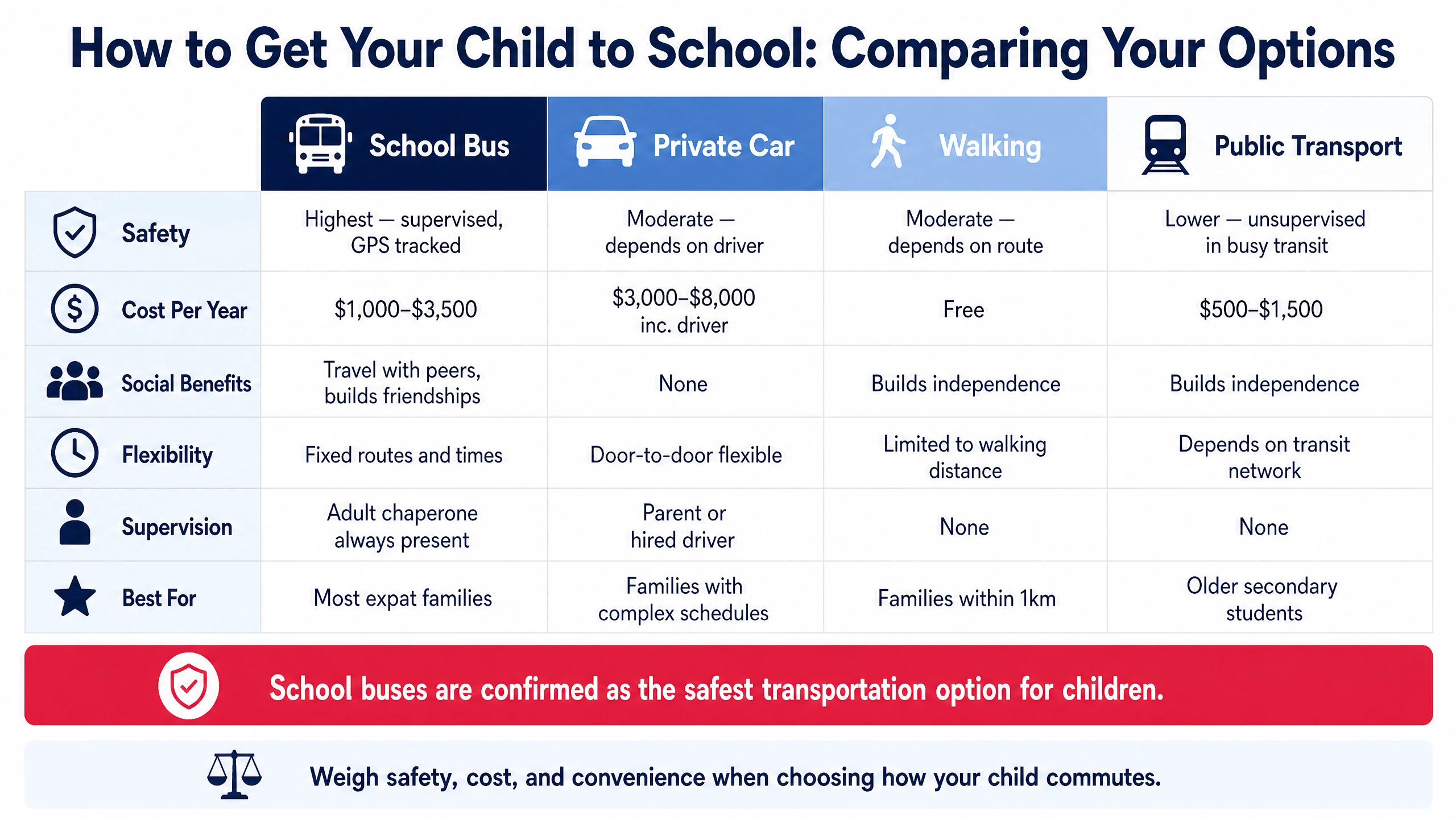
While a school bus is the most popular choice, it is not the only option available. Some parents prefer the flexibility of a private car service or an after-school nanny who can also handle the commute. This option is particularly common in regions like the UAE, where schools such as Dulwich College Dubai are often accessible via private hire services.
For families living very close to the school, walking might be the best alternative. It encourages physical activity and independence, provided the local environment is safe and pedestrian-friendly. Public transport is another viable option in cities with excellent transit networks, such as Singapore, though it requires a higher level of maturity from the child to navigate safely alone.
When comparing school bus vs private car, parents must weigh the trade-off between flexibility and routine. School buses are confirmed as the safest transportation option for children, reinforcing the case for choosing a dedicated service over alternatives. The school bus vs walking vs public transport debate often comes down to safety and convenience. A private car offers door-to-door convenience but lacks the social benefits and structured supervision of a dedicated school bus.
How to evaluate the quality of an international school bus service
Not all school bus services are created equal. When assessing a potential school, parents should ask direct questions about their transport operations.
When you ask what to ask about school bus service during a school tour, start with the basics. Inquire about the ratio of children to chaperones. A good school bus service should have a responsible adult on board at all times, especially for younger students. Ask about the driver training programme and whether the company conducts regular background checks.
You should also investigate the school bus contract terms. Are there penalties for late pick-ups? What is the cancellation policy if your child becomes sick and cannot take the bus for a day? Understanding these logistical details will help you avoid unexpected fees and ensure the service aligns with your family's needs.
Age requirements and when children can travel alone
The question of age appropriateness is a common concern for parents. Generally, international schools expect children to be supervised by an adult during the entire bus journey. Exact age thresholds and supervision requirements are typically published in a school's transport policy and can be reviewed before enrolling. Most operators do not allow young children (under 8 or 9 years old) to board without supervision, which is why school bus age requirements are strictly enforced across Asia.
As children grow older and demonstrate responsibility, schools may relax these rules. By the time a student reaches secondary school, they are often permitted to travel to and from the boarding point independently. However, this decision ultimately rests with the parents. It is vital to assess your own child's maturity and awareness of road safety before allowing them to navigate the commute without supervision.
In contrast, in larger, more sprawling cities like Bangkok or Kuala Lumpur, routes are longer and more diverse. At schools like St Andrews International School Bangkok or Garden International School, parents often have more say in customising their routes or sharing rides to reduce costs.
In South Korea, fully insured buses equipped with GPS and two-way radios are the standard for managing transport safely across busy regions like Seoul.

Frequently Asked Questions
How much does a school bus typically cost in international schools across Asia? The average school bus cost per year ranges from $1,000 to $3,500 USD depending on the city, the distance from home to school, and whether the route is shared with other families.
At what age can my child ride the school bus alone? Most international schools require children to be supervised by an adult at the bus stop until they are at least 8 or 9 years old. Older students in secondary school are generally permitted to travel unsupervised.
What should I do if my child misses the school bus? If a child misses the bus, they are typically considered a late arrival at school. Parents must arrange alternative transport to get the child to the school safely, as the bus will not turn around.
Are school buses safer than driving my child to school? Yes. Professional school buses adhere to strict safety standards, are driven by trained personnel, and are equipped with features like GPS tracking and secure seating. They are statistically the safest way for children to commute, making them far safer than private vehicles navigating busy morning traffic.
Does the international school bus service include after-school activities? This depends entirely on the school. Some schools offer a separate "activity bus" that runs later in the afternoon specifically for students staying for after-school clubs or sports, but this is usually an add-on service.
doris is a free, impartial international school discovery platform designed to help parents find the right international school for their children worldwide. Every school profile includes fees, curriculum, admissions, pupil numbers and more. Parents can compare schools, contact schools directly, access expert parent guides, and connect with a community of parents around the world. Start your search at doris.
This guide was written by Aditya A, part of the doris editorial team. doris sources school data from institutions worldwide and speaks directly with parents navigating the school search process. Fee data reflects published and publicly available information for the 2026 to 2027 academic year and is reviewed annually. Schools are listed for informational purposes only. doris does not rank or promote any school.