.svg)
 By
·
7 minute read
By
·
7 minute read
If you're researching international schools, you've probably come across two curricula that keep popping up: the IB (International Baccalaureate) and the British Curriculum (IGCSE & A-Levels). Both are globally recognized, but they're fundamentally different. The IB requires students to study six subjects across multiple disciplines throughout their studies, while the British system allows students to specialize in 3-4 subjects at A-Level. University acceptance data shows IB students have a 22% higher acceptance rate to top universities, though both qualifications open doors worldwide.
Parents often ask: "Which curriculum is better?" The honest answer is that neither is inherently better. Instead, each curriculum excels for different types of learners. A curriculum that's perfect for one child may not be ideal for another. The key is understanding how each system works and matching it to your child's unique profile.
IB vs British Curriculum Structure: Specialisation vs Breadth
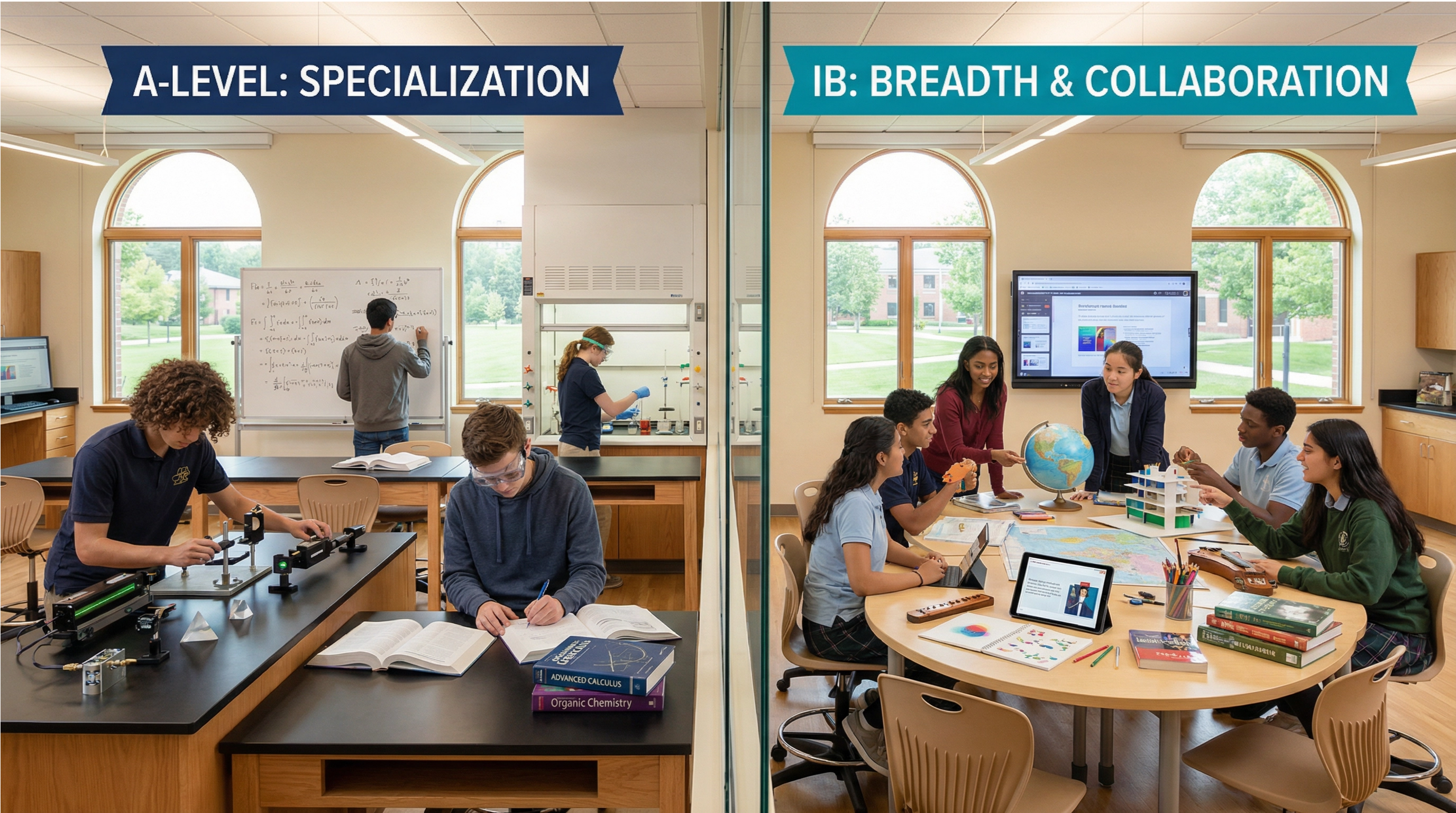
The most significant difference between the two curricula comes down to how they approach learning and knowledge. The British Curriculum champions specialisation and subject-specific depth, while the IB is built on academic breadth and interdisciplinary connections.
British Curriculum Structure (IGCSE & A-Levels)
The British system allows students to narrow their focus progressively as they advance through secondary school. This structure provides a clear pathway to specialisation that appeals to many families.
IGCSE (Grades 9-10): Students study a broad foundation of typically 7-8 subjects, including compulsory subjects like English, Mathematics, and Sciences, alongside electives chosen based on their interests. This breadth ensures that students maintain a well-rounded education while beginning to identify their academic strengths and preferences.
A-Levels (Grades 11-12): After completing their IGCSE exams, students specialize in just 3-4 subjects that align with their interests and university aspirations. This focused approach allows students to develop deep, expert-level knowledge in their chosen fields. The specialisation at A-Level mirrors the independent, focused learning that students will encounter at university, making it an excellent preparation for higher education. A student passionate about physics, for example, can dedicate significant time to mastering advanced concepts in physics, mathematics, and related subjects.
International Baccalaureate Structure (MYP & IBDP)
The IB requires students to maintain a broad range of subjects throughout their studies. This commitment to breadth is central to the IB philosophy and sets it apart from the British Curriculum.
Middle Years Programme (MYP, Grades 6-10): Students study eight subject groups covering languages, sciences, mathematics, humanities, and the arts. The MYP is designed to be interdisciplinary, encouraging students to make connections between different areas of knowledge and apply their learning to real-world contexts. The MYP develops well-rounded thinkers who can see relationships between different disciplines.
Diploma Programme (IBDP, Grades 11-12): Even at the advanced level, IB students must study six subjects across different disciplines. These include two languages, mathematics, sciences, humanities, and an elective. This requirement ensures that IB students develop a genuinely well-rounded education. Beyond subject study, IBDP students complete three core components: Theory of Knowledge (TOK), an Extended Essay (EE), and Creativity, Activity, Service (CAS). These components are designed to develop critical thinking, research skills, and a commitment to personal development and community engagement.
|
Curriculum Element |
British Curriculum |
International Baccalaureate (IB) |
|
Educational Philosophy |
Specialisation and Depth |
Breadth and Interdisciplinary Learning |
|
Subject Structure |
7-8 subjects (IGCSE) → 3-4 subjects (A-Levels) |
8 subject groups (MYP) → 6 subjects (IBDP) |
|
Core Components |
Subject-specific study only |
Theory of Knowledge, Extended Essay, Creativity/Activity/Service |
|
Interdisciplinary Focus |
Subjects studied independently |
Strong emphasis on connections across disciplines |
|
Best Suited For |
Students with clear subject passions |
All-rounders who enjoy variety and connection-making |

How IB and British Curricula Assess Students
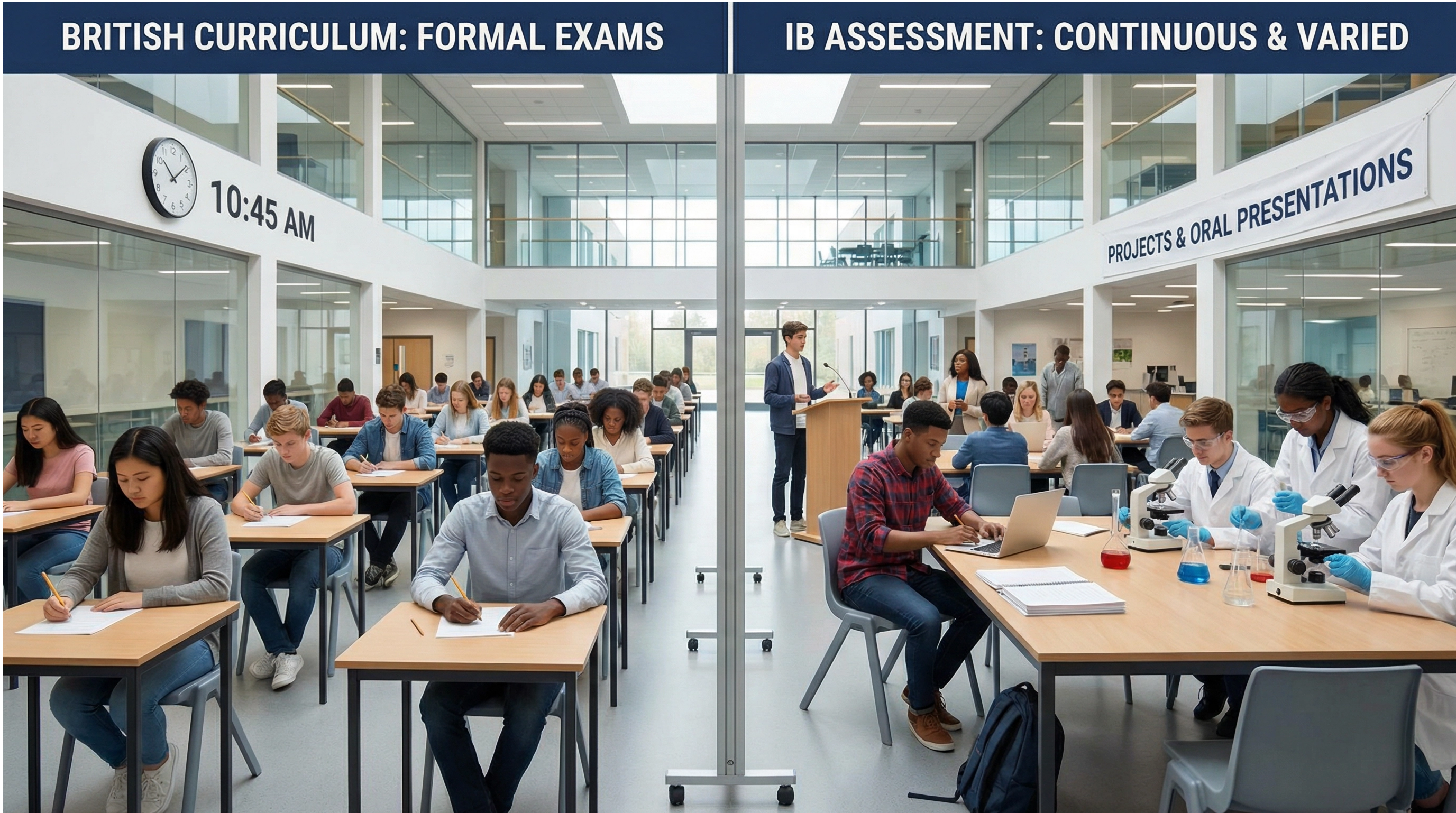
The two systems also differ significantly in how they assess student progress and achievement. The British Curriculum is known for its structured, exam-based assessment, while the IB employs a holistic model that combines final exams with continuous coursework and internal assessment.
British Curriculum Assessment
In the British system, students are primarily assessed through externally marked final exams at the end of IGCSE and A-Level programmes. This approach provides a clear, objective measure of a student's subject knowledge and understanding. The exam-focused model is ideal for students who perform well under exam conditions and benefit from a clear, structured approach to learning.
Mock exams and revision support throughout the year help students prepare systematically for their final assessments. Teachers provide targeted revision guidance, helping students identify areas for improvement and develop effective study strategies. Students know exactly what will be tested and in what format, allowing them to focus their study efforts effectively and approach exams with confidence.
International Baccalaureate Assessment
The IB uses a mix of internal and external assessments throughout the programme, creating a more continuous and holistic evaluation process. While students do sit for final exams, a significant portion of their grade is based on coursework completed throughout the programme. This includes essays, oral presentations, scientific investigations, and other forms of assessment.
Teachers assess student work continuously throughout the course, providing ongoing feedback and evaluation. This means that students' grades are not determined by a single exam performance. The Extended Essay (4,000-word independent research paper) and Theory of Knowledge (1,600-word essay plus exhibition) are assessed both internally and externally, contributing significantly to the final IBDP grade. This diverse assessment approach is designed to capture different types of learning and allow students to demonstrate their knowledge in multiple ways.
|
Assessment Element |
British Curriculum |
International Baccalaureate (IB) |
|
Primary Assessment Method |
Final external exams |
Mix of internal and external assessment |
|
Continuous Coursework |
Limited; mainly revision support |
Significant; ongoing throughout programme |
|
Exam Format |
Structured, externally marked |
Combination of exams and coursework |
|
Practical Components |
Subject-dependent |
Integrated throughout, especially sciences |
|
Student Workload Pattern |
Increases toward final exams |
Consistently high throughout programme |
University Acceptance Rates: IB vs A-Levels
Both A-Levels and the IBDP are highly respected by universities worldwide and provide a clear pathway to higher education. However, research suggests that the IB may have a slight statistical edge when it comes to admission to top-tier universities, though both qualifications are globally recognized and valued.
IB University Recognition
A 2025 study found that IB students have a 22% higher acceptance rate to top universities compared to the general student population. Research specific to UK universities shows 40.1% of IB candidates were accepted into a top 20 UK institution, compared to just 23.7% of A-Level students. For Ivy League universities, the IB acceptance rate is up to 18% higher than the average. Many universities award course credits to IB Diploma students, allowing faster degree progression.
A-Level University Recognition
A-Levels remain a gold standard qualification, recognised by universities in over 125 countries. Universities value the focused, expert-level knowledge that A-Level students develop. Many top institutions, including ETH Zurich, have specific grade requirements for A-Level applicants. In the UK, A-Levels are the standard qualification for university entry and are equally respected by international institutions.
|
University Admission Factor |
International Baccalaureate (IB) |
British Curriculum (A-Levels) |
|
Top University Acceptance Rate |
40.1% (Top 20 UK universities) |
23.7% (Top 20 UK universities) |
|
Ivy League Advantage |
Up to 18% higher than average |
No specific statistical advantage |
|
Global Recognition |
2,000+ schools in 75+ countries |
Accepted in over 125 countries |
|
University Credits |
Often awarded for higher-level subjects |
Varies by university and country |
|
UK University Recognition |
Highly respected |
Standard qualification for entry |
Which Curriculum Is Best for Your Child: IB or British?
Ultimately, the decision between the IB and the British Curriculum should be based on your child's individual learning style, academic strengths, personality, and future aspirations. Neither system is inherently "better," but one may be a significantly better fit for your child's unique profile.
The British Curriculum is a strong fit for students who:
- Have clear subject interests and wish to specialise early.
- Prefer structured learning with clear expectations and transparent assessment criteria.
- Excel in exam-based assessments and perform well under pressure.
- Benefit from a focused approach and prefer to master fewer subjects deeply.
The IB Programme is ideal for students who:
- Are all-rounders who enjoy balancing multiple subjects and making connections across disciplines.
- Thrive on self-directed inquiry, independent research, and interdisciplinary thinking.
- Can manage a consistently high workload and continuous assessment.
- Are motivated by personal development and global perspectives.
Practical Considerations for Parents
Beyond academic philosophy and structure, there are several practical factors that parents should consider when making this decision.
Cost: IB schools can be more expensive than British curriculum schools due to the comprehensive nature of the programme and the extensive training required for IB teachers. However, costs vary significantly by country, school, and location. It's worth comparing specific schools in your area rather than assuming one system is universally more expensive.
Workload: The IB demands a consistently high level of effort across all subjects throughout the programme. Students must manage multiple coursework deadlines, research projects, and continuous assessments alongside their exam preparation. This sustained workload can be challenging for some students but rewarding for those who thrive on variety and continuous engagement.
The British Curriculum's workload tends to intensify in the final exam years, particularly at A-Level. Students may have more flexibility in earlier years but face significant pressure during their final examination periods. This can be advantageous for students who prefer to build intensity gradually or who need time to identify their subject interests before committing to specialisation.
Global Mobility: For families who may relocate frequently, the global network of IB schools can offer greater continuity. With over 2,000 IB schools in 75+ countries, families can often find IB schools in their new location, allowing students to continue their IB studies without interruption. The British Curriculum is also widely available in international schools around the world, particularly in Commonwealth countries.
University Preparation: Both systems prepare students well for university, but in different ways. The IB's emphasis on independent research, critical thinking, and time management directly mirrors university-level study. A-Level students develop deep subject expertise and are well-prepared for focused university study in their chosen fields.

Frequently Asked Questions (FAQ)
1. Is the IB harder than A-Levels?
Neither is definitively "harder," but they are challenging in different ways. The IB's workload is consistently high across six subjects, while A-Levels demand deeper knowledge in fewer subjects, with pressure concentrated around final exams. The best fit depends on whether your child prefers sustained, broad effort or intense, focused study.
2. Which curriculum is better for university admissions?
Both are highly respected. Statistically, IB students have a higher acceptance rate to top-tier universities, particularly in the US and UK. However, A-Levels are the gold standard in the UK and are equally valued worldwide. Universities are more interested in a student's individual performance than the curriculum itself.
3. Can my child switch from the British curriculum to the IB (or vice versa)?
It's possible but can be challenging. Switching after IGCSEs (Grade 10) to the IBDP is a common transition point. Moving from the IB to A-Levels is less common and may require careful subject alignment. It's best to consult with school admissions teams to understand the specific requirements.
4. How much more expensive is the IB compared to the British curriculum?
IB schools are often more expensive due to higher teacher training costs, extensive resource requirements, and IB affiliation fees. However, this varies greatly by country and school. Always compare the specific schools you're considering rather than making assumptions.
5. Which curriculum is better for STEM vs. humanities students?
The British Curriculum (A-Levels) is often favored by students with a clear passion for STEM or humanities, as it allows for deep specialisation. The IB is excellent for students who want to combine both, such as a future doctor who also loves history, as it requires a balanced course load.