.svg)
 By
·
7 minute read
By
·
7 minute read
If you are relocating to Asia or already living here as an expat, finding the right international school for your child is a priority, but the associated costs can be a significant concern. Regional tuition fees vary dramatically, making early financial planning essential. Many international schools across the region offer various forms of financial support to make high-quality education more accessible. Whether your child excels academically, has exceptional sporting talent, or if your family needs financial assistance, there are options available. The real difference lies in understanding the eight critical factors: the types of scholarships on offer, the application process, the eligibility criteria, the renewal conditions, the coverage percentages, where to find opportunities, how to apply, and what alternatives exist if school-specific awards are not available. If you are an expat family navigating this landscape, understanding these elements will ensure you secure the best educational opportunity for your child without compromising your financial stability.
International school scholarships explain what financial support is available
International schools across Asia provide a diverse range of financial support options to attract talented students and support families in need. Understanding the different types of financial support international school options is the first step in finding the right fit for your child. NAFSA confirms the fundamental distinctions between various aid types. Merit-based awards recognise academic or extracurricular excellence, while need-based assistance is determined by a family's financial situation. Many schools also offer talent-specific awards for students excelling in sports, music, or the arts. When you visit schools, ask the admissions team to detail the specific scholarship types they offer, as the availability and criteria can vary significantly between institutions. Schools that can clearly explain their financial support structures are demonstrating the transparency you want to see.

Merit based scholarships reward academic excellence and extracurricular achievements
Academic excellence is often the primary criterion for securing significant fee reductions. Merit based scholarships are awarded to students who demonstrate consistently high academic performance, intellectual curiosity, and a strong track record of results. These awards typically cover between 10% and 100% of tuition fees. To qualify, students usually need to be in the top 5-10% of their cohort and achieve excellent scores in standardised entrance exams. The International Baccalaureate Organization supports students through specific programmes that recognise outstanding achievement within the IB curriculum. If you are aiming for an academic scholarships international school, ensure your child's academic records are exceptional and that their personal statement highlights their intellectual engagement rather than just compliance. When you visit schools, ask how they assess intellectual curiosity, as this is a key differentiator for top-tier academic excellence award recipients.
Need based scholarships and bursaries provide financial assistance to families
For families facing financial constraints, need based scholarships and bursaries offer a vital lifeline. These awards are means-tested, requiring families to provide detailed financial documentation, including tax returns, bank statements, and proof of income. The U.S. Department of Education confirms how international financial aid is structured, which provides a useful reference for understanding the documentation required. Need-based support is particularly common in the UK independent school tradition, where many schools allocate significant endowment funds to bursary programmes. Some schools offer bursaries covering up to 100% of fees, plus additional support for uniforms, trips, and exam fees. If you require a need based bursary international school, be prepared to discuss your financial situation openly but discreetly, as schools handle these applications with strict confidentiality. It is also worth noting that many schools combine financial aid for international students with merit awards for a larger total package.
How to apply for an international school scholarship and prepare your documents
The application process is highly competitive and requires meticulous preparation. Families should start researching international school scholarships 12 to 18 months before the intended entry date. World Education Services offers a comprehensive guide on funding your education, which is invaluable for understanding the broader landscape. To apply for an international school scholarship application, you will need to gather academic transcripts from the last two to three years, standardised test scores, and strong teacher recommendations. A compelling personal statement is crucial; it should be specific, demonstrate growth, and connect your child's goals to the school's values. Scholarship application deadlines are often earlier than standard admissions deadlines, so keeping a detailed timeline is essential. If you are preparing an international school scholarship application, ensure all documents are submitted well in advance of the deadline to allow for any unexpected delays.

What are the scholarship eligibility requirements and renewal conditions
Securing a scholarship is only the beginning; maintaining it requires ongoing effort and adherence to specific conditions. Scholarship eligibility requirements vary by school, but typically involve maintaining a minimum grade average (often a B+ or higher) and meeting strict behaviour and attendance expectations. For need-based bursaries, the family's financial situation is reassessed annually to ensure the support is still warranted. The British Council provides extensive information on UK-style scholarship pathways, which many international schools in Asia follow, highlighting the importance of continuous academic engagement. If your child receives an academic scholarships international school award, you must be prepared for regular reviews of their progress. Schools expect scholarship recipients to be active contributors to the school community, so involvement in extracurricular activities is highly valued. Understanding the scholarship renewal requirements early on will help your child manage their academic and extracurricular commitments effectively.
Where to find international school scholarships in Asia and other regions
Finding the right opportunity requires a systematic approach. Check the school's website beyond the homepage, in the admissions and fees sections, and review the school's profile on doris, where scholarship and financial aid details are often listed alongside fees. If the information is vague, email the admissions team directly. The Singapore Ministry of Education operates a well-known ASEAN scholarship programme, showing that national portals are worth checking for regional opportunities. Also consider your employer: many multinational companies include education allowances in relocation packages, which can be combined with a scholarship for real savings. A relocation agent can sometimes point to scholarships that are not publicly advertised.
How much of your international school tuition fees can scholarships cover
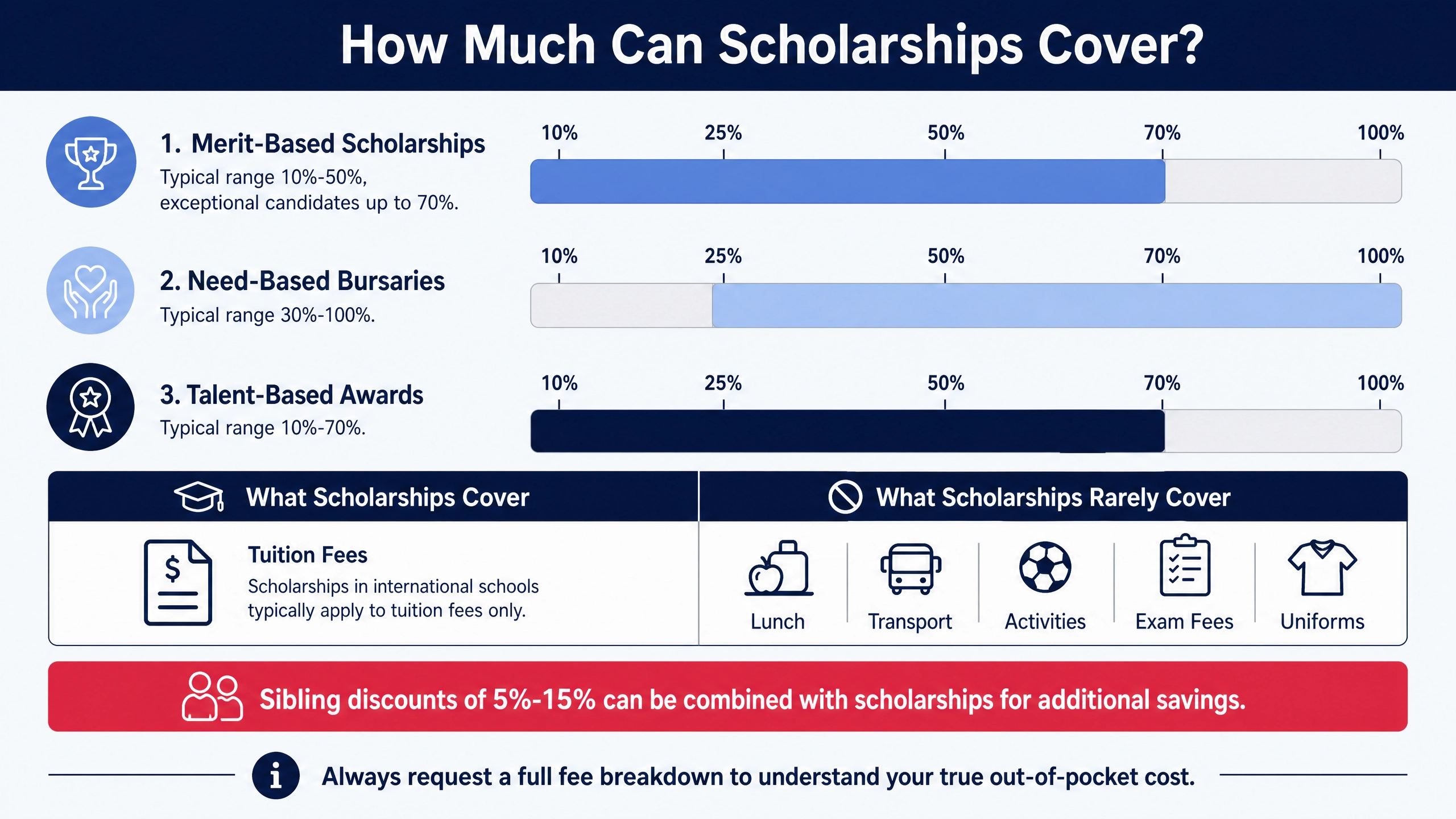
The amount of financial support varies widely depending on the type of scholarship and the school's resources. Merit-based awards typically cover between 10% and 50% of tuition, while exceptional candidates in senior years might receive up to 70%. Need-based bursaries can cover anywhere from 30% to 100% of fees, depending on the family's proven financial need. ISC Research provides comprehensive data on the international schools market, which can help you understand the typical international school tuition fees and how scholarships impact the overall cost. It is important to note that scholarships usually apply only to tuition fees; non-tuition costs such as lunch, bus services, activities, and exam fees are rarely covered in full. However, many schools offer international school fee assistance in the form of sibling discounts, typically ranging from 5% to 15% for subsequent children. Understanding how to reduce international school fees through a combination of scholarships and discounts is crucial for effective international school cost planning.
|
Region |
School Name |
Typical Annual Fees (USD) |
Common Scholarship Types |
|---|---|---|---|
|
Singapore |
$12,700 - $20,358 |
Merit, Need-based |
|
|
Singapore |
$7,749 - $18,121 |
Merit, IB Diploma |
|
|
Thailand |
$10,000 - $22,000 |
Academic, Talent |
|
|
Thailand |
$8,500 - $18,000 |
Academic, Sports |
|
|
Malaysia |
$8,000 - $22,000 |
Merit, Need-based |
|
|
Malaysia |
$6,500 - $18,500 |
Academic, Talent |
|
|
South Korea |
$12,000 - $28,000 |
Merit, Need-based |
|
|
South Korea |
$10,000 - $25,000 |
Academic, Arts |
|
|
Japan |
$15,000 - $28,000 |
Merit, Need-based |
|
|
Japan |
$12,000 - $24,000 |
Academic, Talent |
|
|
China |
$12,000 - $28,000 |
Merit, Need-based |
|
|
China |
$10,000 - $25,000 |
Academic, Sports |
|
|
Taiwan |
$10,000 - $22,000 |
Merit, Need-based |
|
|
Taiwan |
$8,000 - $18,000 |
Academic, Talent |
|
|
Indonesia |
$10,000 - $25,000 |
Merit, Need-based |
|
|
Indonesia |
$7,000 - $15,000 |
Academic, Sports |
|
|
UAE |
$12,000 - $28,000 |
Merit, Need-based |
|
|
UAE |
$8,000 - $20,000 |
Academic, Talent |

What alternatives exist if international school scholarships are not available
If your child does not qualify for a school-specific scholarship, there are several alternative pathways to make international education more affordable. The most common solution is to negotiate an education allowance as part of your relocation package. A corporate education allowance international school can cover a significant portion of the fees, and many companies are willing to increase this amount if you present a strong case. Government grants, such as the ASEAN scholarship, can also provide substantial support. UNESCO offers various fellowships and funding opportunities that can be adapted for different educational needs. Additionally, exploring international school funding options like low-interest education loans or payment plans offered by the schools themselves can ease the financial burden. If cost remains a primary concern, researching more affordable international school options in secondary cities or less expensive regions can provide a high-quality education at a fraction of the cost of a premium urban campus.
Frequently Asked Questions
What is the typical percentage of tuition covered by an international school scholarship? Merit-based scholarships typically cover between 10% and 50% of tuition fees, while exceptional academic or talent awards can reach up to 70% to 100%. Need-based bursaries can also cover 30% to 100% of fees, depending on the family's proven financial need and the school's endowment.
When should families start applying for international school scholarships? Families should begin researching and preparing for scholarships 12 to 18 months before the intended school entry date. Application deadlines are often several months earlier than standard admissions deadlines, requiring ample time to gather transcripts, prepare personal statements, and arrange for teacher recommendations.
Can international school scholarships be combined with other financial aid? Yes, many schools allow the combination of different types of financial support. It is common for a student to receive a merit-based scholarship that is then supplemented by a need-based bursary. Additionally, a school scholarship can often be combined with a corporate education allowance provided by the parent's employer.
What documents are required for a need-based international school bursary? Applications for need-based bursaries require comprehensive financial documentation to prove financial hardship. This typically includes recent tax returns, payslips, bank statements, proof of income, and details of any outstanding debts or significant financial commitments.
How can expat families access corporate education allowances for international school fees? Expat families should proactively discuss education allowances with their Human Resources department during the negotiation of their relocation package. Presenting a detailed breakdown of the intended school's tuition fees and explaining how the education will benefit the family's stability can help secure a more substantial allowance.
doris is a free, impartial international school discovery platform designed to help parents find the right international school for their children worldwide. Every school profile includes fees, curriculum, admissions, pupil numbers and more. Parents can compare schools, contact schools directly, access expert parent guides, and connect with a community of parents around the world. Start your search at doris.
This guide was written by Aditya A, part of the doris editorial team. doris sources school data from institutions worldwide and speaks directly with parents navigating the school search process. Fee data reflects published and publicly available information for the 2026 to 2027 academic year and is reviewed annually. Schools are listed for informational purposes only. doris does not rank or promote any school.