.svg)
 By
·
7 minute read
By
·
7 minute read
The cost of international schools in Hong Kong varies by year group and school, but annual tuition is only the starting point. Parents may also pay application and assessment fees, entry fees, capital levies, debentures, reservation deposits, transport, meals, uniforms, devices, examinations, activities and boarding. This guide compares current 2026/27 reference figures, explains the main cost categories, and shows how to build a realistic budget before accepting a place for 2027/28.

What international school tuition costs in Hong Kong
Parents comparing Hong Kong international school fees will find a wide spread across year groups. Kellett lists HK$218,200 for Preparatory to Year 6, HK$271,300 for Years 7–11 and HK$279,100 for Years 12–13. Harrow lists HK$182,493 for Nursery and Reception, HK$208,964 for Years 1–5, HK$238,687 for Years 6–11 and HK$248,155 for Years 12–13. These figures come from the schools’ current published tuition tables and current fee policy.
Other schools use different grade bands and payment systems. American School Hong Kong lists 2026/27 tuition from HK$170,600 for KG to HK$242,700 for Grades 11–12. Canadian International School of Hong Kong lists HK$161,000 for EY1, HK$217,200 for Preparatory to Grade 2, HK$223,100 for Grades 6–8 and HK$261,500 for Grades 11–12. These figures come from the schools’ published grade-by-grade fee information and current fee breakdown. They cannot be compared without checking what each school includes, which year group applies, and whether programme or technology charges sit inside the headline tuition.
The fee year matters. A school may publish 2026/27 prices while a family is planning for 2027/28. Schools review fees annually, and some pages state that changes require Education Bureau approval. Treat the latest published figure as a planning reference. The current school-fee framework provides policy context. Each school’s finance office must confirm the fee schedule for your child’s intended entry year.
Which extra school fees families must budget for

Tuition rarely represents the full first-year cost. These hidden costs can change the decision between two schools. Create a separate line for each charge before comparing schools.
An application fee is usually paid before an assessment or decision. HKIS lists HK$2,000, ASHK lists HK$900 and Harrow lists HK$1,500. The current tuition and levy schedule shows how this payment sits beside later school charges. These fees are non-refundable at the schools named here. A fee may cover administration or assessment, but it does not guarantee an interview or a place.
An entry or registration fee may apply after an offer. HKIS lists a one-time HK$15,000 entry fee for new students. CDNIS lists a one-time HK$12,500 entry fee for EY1 and above in its current entry-fee and capital-levy schedule. These payments sit beside tuition and may remain payable when a child starts after the academic year begins.
Capital charges take several forms. CDNIS lists a HK$43,000 annual capital levy for EY1 and above unless the student is covered by a debenture. ASHK lists a HK$45,000 capital fee for newly admitted students and a HK$29,500 annual capital fee for re-enrolling students, alongside a one-time HK$150,000 capital fee option. ESF lists non-refundable capital levies, building levies and other charges that vary by school and entry year in its current school-fee and other-charge schedule.
Everyday costs can change the household budget too. Schools may charge separately for buses, lunch, uniforms, laptops, iPads, field trips, experience weeks, music lessons, activities, examination fees and overseas expeditions. Ask whether IB fees or other examination charges are already included. Harrow excludes textbooks in specified years, examination fees in Years 10–13, uniform, lunch, snacks, transport, trips and individual music lessons from its tuition. Its boarding fees are also separate from tuition. CDNIS lists devices, uniforms, optional lunch, bus services and experience weeks, with some experience-week costs ranging from HK$1,500 to HK$60,000.

How capital levies debentures and deposits work
These terms describe different payments. Parents should never treat them as interchangeable.
A capital levy is a charge used for school facilities or long-term development. It may be annual or one-off, refundable or non-refundable, and may vary by entry year. A school debenture is a separate financial instrument or school entitlement with its own terms. Some schools use debentures to support capital funding or nomination arrangements. A nomination right may provide an application or interview priority route, subject to the school’s admissions requirements. A reservation deposit is usually paid after an offer to secure the place and may later offset tuition.
The payment does not automatically guarantee admission. HKIS states that its optional debentures do not guarantee admission. Kellett states that all students must be covered by a debenture or annual capital levy and that its annual capital levy does not confer priority admission. The published capital and debenture terms also show why parents need the exact conditions in writing before comparing a charge with another school’s levy.
Refund rules need close attention. A deposit may offset the first or last month’s fee if the parent gives the required withdrawal notice. A capital levy may be non-refundable and non-transferable. A debenture may have separate transfer, redemption or depreciation rules. Ask for the written terms before transferring money.
How Hong Kong school fees vary by year group and school
The Doris directory gives parents a useful starting comparison. The figures below are current directory references, not guaranteed 2027/28 quotations. The table does not rank the schools.
|
School |
Location and ages |
Curriculum |
Doris fee reference |
Cost question to ask |
|---|---|---|---|---|
|
Sai Kung; ages 3–18 |
IB PYP, MYP and DP |
HK$119,000–273,900 |
Which annual levies, transport and activity charges apply to the child’s year? |
|
|
Tai Po; ages 5–18 |
IB DP and American Curriculum |
HK$164,800–234,500 |
Is the capital fee or debenture option relevant to this application year? |
|
|
Ho Man Tin; ages 5–18 |
IB DP and American Curriculum |
HK$217,100–264,000 |
Which campus, capital charges and transport costs apply to the intended year group? |
|
|
Aberdeen; ages 2–18 |
IB PYP, MYP, DP and Canadian Curriculum |
HK$156,300–254,300 |
What are the current capital levy, reservation deposit, device and experience-week costs? |
|
|
Lycée Français International French International School - Jardine’s Lookout Campus |
Jardine’s Lookout; ages 6–11 |
French, British, IPC and IMYC |
HK$148,649–161,373 |
Which stream, language support and transport charges apply to the child? |
|
Kowloon Tong; ages 3–8 |
IB PYP |
HK$155,000–165,000 |
Are meals, activities, materials and any registration charges included? |
|
|
Yau Yat Chuen; ages 12–18 |
American Curriculum and AP |
HK$134,000–156,500 |
Which AP, transport, technology and support-service costs sit outside tuition? |
|
|
Stanley; ages 12–18 |
British Curriculum and IB DP |
HK$74,550–150,866 |
How do day, boarding, examination, transport and activity charges combine? |
Doris directory fees help parents build a shortlist, but the finance office remains the source for the current academic year, payment terms, levies, deposits and place-specific charges.
How to build a realistic Hong Kong school budget
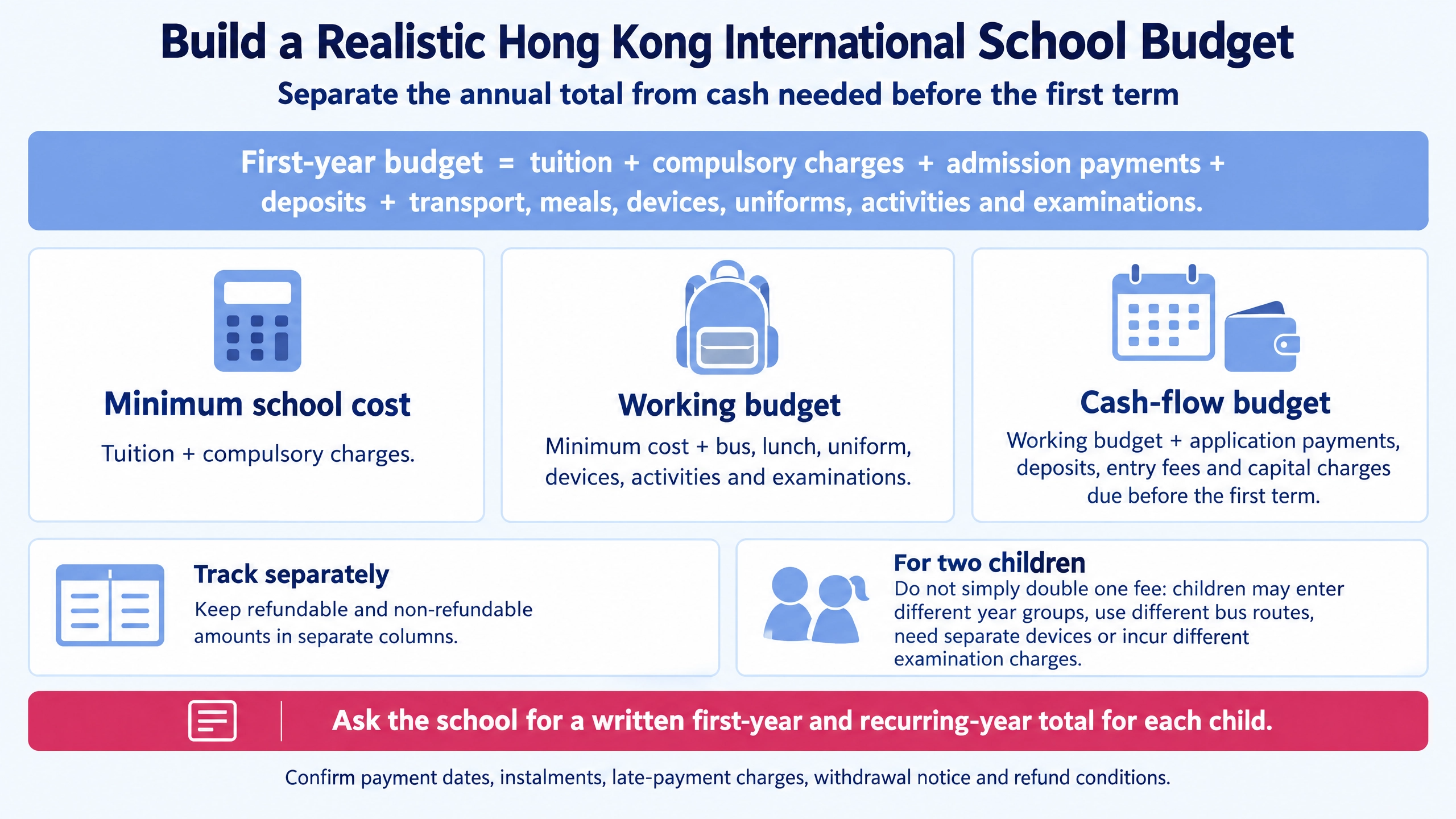
Use this formula for each school:
First-year budget = tuition + compulsory charges + admission payments + deposits + transport, meals, devices, uniforms, activities and examinations.
Keep refundable and non-refundable amounts in separate columns. A large reservation deposit can affect cash flow even when the school later offsets it against tuition. A non-refundable levy affects the true cost permanently. A debenture may need its own analysis because the school’s terms may cover nomination, transfer, redemption or depreciation.
Build three scenarios. The minimum school cost includes tuition and compulsory charges. The working budget adds bus, lunch, uniform, devices, activities and examinations. The cash-flow budget adds application payments, deposits, entry fees and capital charges due before the first term.
For two children, do not simply double one fee. Siblings may enter different year groups, use different bus routes, require separate devices or incur different examination charges. Some schools offer sibling discounts, while others apply the same levy or deposit per child. Ask for a written calculation for each child and a combined payment calendar.
How employer support scholarships and payment terms affect cost
An employer package may cover tuition but exclude levies, deposits, transport, uniforms, devices, activities or boarding. Ask the employer to specify the annual allowance, payment method, exchange-rate rule, tax treatment, reimbursement timing and responsibility for non-refundable charges.
The parent remains responsible where the school’s terms place payment responsibility on the family, even if an employer pays the invoice. ESF’s published fee information states that parents remain responsible for school fees regardless of whether an employer or another third party pays. Check the same clause in every school’s contract.
Ask whether the school offers scholarships, financial assistance or sibling discounts. These arrangements differ by school and may have separate application dates. Do not reduce your budget until the school confirms the award in writing. Instalments can improve cash flow without reducing the annual cost. Ask whether the school offers payment plans or only fixed instalments. Confirm the due dates, autopay rules, late-payment charges, withdrawal notice and refund conditions.

What the cost of applying to a Hong Kong international school includes
The application stage can require money before a school offers a place. Common early costs include an application fee, assessment fee, language test, document certification, translation, interview travel, campus visit and courier or administrative costs. These payments may be non-refundable and may not secure an interview.
After an offer, the family may need to pay a reservation deposit, entry fee, capital levy, annual association fee or other charge within a short deadline. CDNIS states that a reservation deposit is required to secure an EY1 or above place for its published academic year. HKIS states that a new-student reservation deposit is required at acceptance and describes the conditions for refund. Read the offer, fee schedule and enrolment contract together.
Before applying, ask for the current fee schedule, compulsory first-year charges, refund terms, withdrawal terms and payment deadline. Also request transport, meals, devices, uniforms, activities and examination costs. A written schedule is more useful than asking only, “What are your school fees?”
What to ask before accepting an international-school place
Use the following checklist when comparing schools:
- What is the exact tuition for the child’s grade and academic year?
- Which charges are compulsory, optional, refundable, non-refundable or non-transferable?
- Is there an application fee, assessment fee, entry fee, capital levy, debenture or nomination right?
- What reservation deposit is required, and when is it returned or credited?
- Are transport, meals, uniforms, devices, examinations, trips and activities included?
- Does the school charge separately for boarding, music lessons, learning support or language support?
- What payment schedule, autopay rule, late fee and withdrawal notice apply?
- Can the school provide a written first-year and recurring-year total for this child?
Frequently Asked Questions
How much does an international school cost in Hong Kong each year?
Current 2026/27 official pages show annual tuition ranging from below HK$150,000 in some early-years or lower-fee options to above HK$270,000 in senior year groups. The total family cost can be higher once compulsory levies, deposits and everyday extras are included.
What is the difference between a capital levy and a debenture?
A capital levy is a school charge that supports long-term development. A debenture has separate contractual terms and may relate to nomination or capital funding. Refund, transfer and admission effects vary, so read the school’s current terms.
What extra costs should parents add to tuition?
Budget for application and assessment fees, entry fees, capital charges, deposits, bus, lunch, uniforms, devices, examinations, activities, trips, music, learning support and boarding where relevant.
Is a Hong Kong international-school reservation deposit refundable?
There is no universal rule. Some schools offset a deposit against tuition or return it after the required withdrawal notice. Others apply strict deadlines or non-refundable terms. Ask for the written policy before paying.
How can parents compare the total cost of two schools fairly?
Compare the same academic year and year group. Put tuition, compulsory charges, deposits, optional services, payment timing and refund rules into separate columns. Request a written cost schedule from both schools.
doris is a free, impartial international school discovery platform designed to help parents find the right international school for their children worldwide. Every school profile includes fees, curriculum, admissions, pupil numbers and more. Parents can compare schools, contact schools directly, access expert parent guides, and connect with a community of parents around the world. Start your search at doris.
This guide was written by Aditya, part of the doris editorial team. doris sources school data from institutions worldwide and speaks directly with parents navigating the school search process. Schools are listed for informational purposes only. doris does not rank or promote any school.