---
title: Complete List of International Schools in Malaysia (2026)
description: Discover the top international schools in Malaysia, their curricula, costs, and tips for selecting the best school for your child in this comprehensive guide.
image: https://blog.doris.school/hubfs/Screenshot%202026-03-09%20at%2016.44.55.png
---
[Skip to content](https://blog.doris.school/complete-list-of-international-schools-in-malaysia#main-content)
[.svg)](https://tips.doris.school/)
- [Ask doris](https://tips.doris.school/chat)
- [Explore events](https://tips.doris.school/schools/events)
- [My shortlist](https://tips.doris.school/parent/dashboard/compare)
Open main navigation
Close main navigation
- [Ask doris](https://tips.doris.school/chat)
- [Explore events](https://tips.doris.school/schools/events)
- [My shortlist](https://tips.doris.school/parent/dashboard/compare)
- [Find schools](https://tips.doris.school/schools)
[Find schools](https://tips.doris.school/schools)
[All posts](https://www.doris.school/international-school-guide)
March 9, 2026
# Complete List of International Schools in Malaysia (2026)
-1.png?width=50&name=Team%20pics%20(2)-1.png) By Aziza F · 4 minute read
If you're moving to Malaysia with children, the good news comes early: you've landed in one of the best-value international school markets in Asia. Over a hundred thousand students are already enrolled across the country, fees are a fraction of other regional hubs, and the academic outcomes speak for themselves. The harder part is choosing.
International school enrolment in Malaysia rose 67% over the last decade, reaching over 111,000 students by 2024. This remarkable growth reflects Malaysia's appeal as a cost-effective alternative to Singapore and Hong Kong while maintaining comparable academic standards. Most international schools in Malaysia follow British, Cambridge, or German curricula, with annual tuition ranging from $3,000 to $60,000 USD per child depending on location, curriculum, and grade level. Malaysia offers established institutions with strong university outcomes and commitment to holistic student development.
## List of International Schools in Malaysia
| **School** | **City** | **Curriculum** |
| --- | --- | --- |
| [Marlborough College Malaysia](https://tips.doris.school/schools/malaysia/marlborough-college-malaysia) | Negeri Sembilan | British |
| [Reigate Grammar School Kuala Lumpur](https://tips.doris.school/schools/malaysia/reigate-grammar-school-kuala-lumpur) | Kuala Lumpur | British + Cambridge |
| [The Alice Smith School](https://tips.doris.school/schools/malaysia/the-alice-smith-school-secondary) | Kuala Lumpur | British |
| [Straits International School Penang](https://tips.doris.school/schools/malaysia/straits-international-school-penang) | Penang | British + Cambridge |
| [Straits International School Rawang](https://tips.doris.school/schools/malaysia/straits-international-school-rawang) | Selangor | British + Cambridge |
| [Sri KDU International School Klang](https://tips.doris.school/schools/malaysia/sri-kdu-international-school-klang) | Klang | British + Cambridge |
| [Rafflesia International School Puchong](https://tips.doris.school/schools/malaysia/rafflesia-international-school-puchong) | Puchong | Cambridge |
| [UCSI International School - Subang Jaya](https://tips.doris.school/schools/malaysia/ucsi-international-school-subang-jaya) | Subang Jaya | Cambridge |
| [Charis International School](https://tips.doris.school/schools/malaysia/charis-international-school) | Kuala Lumpur | Cambridge |
| [Maple Leaf Kingsley International School](https://tips.doris.school/schools/malaysia/maple-leaf-kingsley-international-school) | Klang | British + Cambridge |
| [100 Lambs International School](https://tips.doris.school/schools/malaysia/100-lambs-international-school) | Kuala Lumpur | Cambridge + IPC |
| [German School Kuala Lumpur](https://tips.doris.school/schools/malaysia/german-school-kuala-lumpur) | Kuala Lumpur | German |
| [Borneo International School](https://tips.doris.school/schools/malaysia/borneo-international-school) | Sarawak | British + Cambridge |
The following is a selection of international schools currently listed on doris. Schools are shown for informational purposes only. doris does not rank, rate or promote any school, all listings reflect publicly available information presented impartially.
### [](https://blog.doris.school/hs/cta/wi/redirect?encryptedPayload=AVxigLLDLV65NVjMx%2BBHXnC5vMitJeJei3cde3TPdYY7%2B39f2KVbuv%2BDwLfCJ%2Fckxur4QM3UnV7IxjMZtKcuVQO%2B2Oejx76rUyAa5SZL9As9N%2FF0N2V2P4yN%2FuKAKWZelmasB9UfaduLjkp34PFgcbMlbEHLkKaPWZpTxtcArQpE5fEMUqvKbFX4eqDI5BaM7Q%3D%3D&webInteractiveContentId=376431447280&portalId=145372008)
## **How to Choose an International School in Malaysia**
**Step 1: Selecting curriculum**
British and Cambridge curricula offer direct UK university pathways and preparation for competitive admissions to Russell Group universities. Consider your family's university destination and your child's learning style when selecting a curriculum.
[](https://blog.doris.school/hs/cta/wi/redirect?encryptedPayload=AVxigLL%2BQsgM4Qd8RBWT2bUlEt%2FQTQyrnx0ECyT0aVjmXDrif43VKe7YCeIGr1o4Sb6%2BmDnNJ%2BslzETZlNhNxkob8R%2B6%2BKTZH69sBvkms5XJKNJobq1dZ4NB3oQTAqOxRoG7PLUVCU0VN8DNQUNC84HXyVFCQI50aBJwtaxhqAaQ6uuNqvbM46t2xx84tJB1pxY%3D&webInteractiveContentId=287293311163&portalId=145372008)
**Step 2: Location and commute considerations**
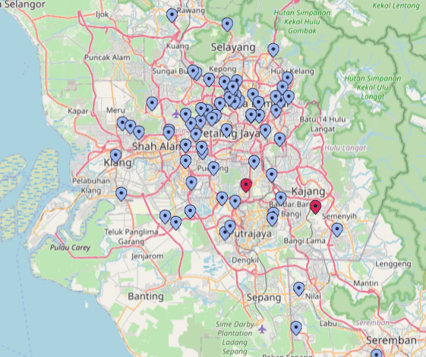
Schools in central Kuala Lumpur and Klang Valley are metro-accessible but command premium fees ($15,000–$60,000 USD). Schools in Penang, Johor Bahru, and Sarawak offer more affordable options ($3,000–$12,000 USD) with different community dynamics. Most schools operate shuttle services; evaluate commute time, traffic patterns, and proximity to your workplace and home.
**Step 3: Campus visits and admissions timeline**
Visit campuses online or offline before applying to assess facilities, observe school culture, and speak with current parents. Most schools operate Northern Hemisphere calendars (August/September start) with rolling admissions. Apply early, as popular schools fill quickly. Request detailed information about curriculum, teaching staff qualifications, facilities, co-curricular offerings, and support services.
**Step 4: Evaluating school culture and well-being**
Observe how students interact with staff and each other. Ask how the school addresses conflict and bullying. Inquire about emotional well-being support, counselling services, and diversity initiatives. Request information about parent communication frequency and community involvement opportunities.
[](https://blog.doris.school/hs/cta/wi/redirect?encryptedPayload=AVxigLJzJzbHgXagyBVVt6FbJ7dm4mJHae8dCNcnnjHkcF4p0yak7f7wDghZ%2FazjEqfHJrqcaXBHSRmsPMQ0boujhH%2B4KQzctRVDqDoT5R%2BDhuW2dT13hHI8F5H%2BabyxYbZElglmVvx9N1tCS5DIvHq3A4V6ElQUANGEfWJ%2FEq4BBbcEGmIEMHwMD7GYZUDE&webInteractiveContentId=376431447285&portalId=145372008)
## **Why Malaysia's International Schools Are Growing Rapidly**
****
Malaysia has emerged as Asia's leading private education destination for expat families and increasingly, Malaysian parents seeking alternative education pathways.
Post-pandemic surge from North Asia: Since 2022, Malaysia has experienced a significant surge in international students whom are self-paying rather than company-sponsored. This trend represents a deliberate choice by affluent Asian families to pursue international education in Malaysia. According to[The Edge Malaysia's 2024 coverage](https://theedgemalaysia.com), the Malaysia My Second Home (MM2H) programme has contributed substantially to this growth.
Geographic expansion:[Kuala Lumpur and Penang are becoming increasingly attractive to expatriates](https://theedgemalaysia.com/node/727019), with new international schools being established in response to growing demand. This expansion is supported by Malaysia's growing economy, foreign direct investments, and strategic location near major international airports (KLIA, Penang International Airport). Emerging cities like Johor Bahru and Cyberjaya are also attracting international school investment.
## **Popular International Schools among relocating families**
Parent communities and online forums consistently highlight several schools as top choices for best international schools in Malaysia. [Alice Smith School](https://tips.doris.school/schools/malaysia/the-alice-smith-school-secondary), [Garden International School](https://tips.doris.school/schools/malaysia/garden-international-school-kuala-lumpur), [Mont Kiara International School](https://tips.doris.school/schools/malaysia/mont-kiara-international-school), and International School of Kuala Lumpur (ISKL) are frequently recommended for their academic excellence, university outcomes, and strong school culture.
According to Reddit discussions and expat forums, parents particularly value smaller schools like [Garden Internationa](https://tips.doris.school/schools/malaysia/garden-international-school-early-years-centre)l for personalised attention and low teacher turnover, while others prefer established institutions like ISKL (founded 1965, serving 1,750+ students from 70+ nationalities) for their diverse, multicultural environment. [Park City](https://tips.doris.school/schools/malaysia/the-international-school-parkcity) International School is noted for its balanced approach to student well-being and healthy lifestyle integration.
👵🏻 One parent shared: "*The teachers were not only friendly but incredibly encouraging, fostering an environment where every question and opinion mattered. My child developed genuine love for learning through this inclusive atmosphere."*
👵🏻 Another noted: *"What impressed me most was the balance between academic rigour and student well-being. The school genuinely cares about developing whole individuals, not just test scores. The university counselling is exceptional, my daughter received personalised guidance for her UK university applications and was accepted to Cambridge."*
Parents also highlight the diverse, multicultural student body as a significant advantage, with schools maintaining 40–65% international student populations. According to[ISKL's diversity policy](https://www.iskl.edu.my), the school ensures "no single nationality exceeds 25% of our student body" to maintain a genuinely international environment. This diversity prepares students for global citizenship and cross-cultural communication skills essential in today's workforce.
## **British International Schools in Malaysia**
British curriculum schools in Malaysia follow the English National Curriculum and[Cambridge International standards](https://www.cambridgeinternational.org), offering direct pathways to UK universities through IGCSE and A-Level qualifications. These curricula focus on preparing students to compete in top UK universities including Cambridge, Oxford, LSE, Imperial College London, and other [Russell Group institutions](https://www.russellgroup.ac.uk/our-universities). Students develop critical thinking, independent research skills, and analytical abilities essential for university-level study.
## **Frequently Asked Questions: International Schools in Malaysia**
Q: How many international schools are in Malaysia?
A: Malaysia has approximately 40–50 international schools, with the highest concentration in Kuala Lumpur and Klang Valley.
Q: What curriculum options exist in Malaysian international schools?
A: The most common curricula are British (40% of schools),[Cambridge International](https://www.cambridgeinternational.org) (35%), and German (5%). Some schools offer combinations of curricula.
Q: How much do international schools in Malaysia cost?
A: Annual tuition ranges from $3,000 to $60,000 USD, depending on school location, curriculum, and grade level. Klang Valley and central Kuala Lumpur schools sit at higher fee bands ($10,000–$60,000 USD). First-year costs typically include registration fees ($500–$2,000) and uniforms ($300–$800). Budget for additional costs including transport, meals, technology, and activities ($3,000–$6,000 annually).
Q: Are there waiting lists for international schools in Malaysia?
A: Popular schools in Kuala Lumpur and Klang Valley often have waiting lists, particularly for primary grades. Early application (6–12 months in advance) and flexibility regarding grade placement improve admission chances.
Q: Can students join international schools mid-year in Malaysia?
A: Mid-year admissions are possible if spaces become available, though additional assessments may be required. Most schools prefer August/September start dates aligned with Northern Hemisphere calendars.
[](https://blog.doris.school/hs/cta/wi/redirect?encryptedPayload=AVxigLLexjc1uoG0Nedggo%2BfDd%2Fxyebs8OyLd%2FTYGgbk908rx8ZXsyRp6YiZwLRJsjmSmAu7kGPWodg%2FAxmetDYbWj3BXfhEPpyzb3RJ8hrFXys6q2cMrcJHPZQUOuaF6bDPuuSA7F4316Hez7tnxMq%2BTxXLIeEwEjuMNLiambCHt7a9CBGMoJ2EAF8bO9F2OWo%3D&webInteractiveContentId=247366451417&portalId=145372008)
Share [facebook-f icon](http://www.facebook.com/share.php?u=https://blog.doris.school/complete-list-of-international-schools-in-malaysia) [linkedin-in icon](http://www.linkedin.com/shareArticle?mini=true&url=https://blog.doris.school/complete-list-of-international-schools-in-malaysia) [twitter icon](https://twitter.com/intent/tweet?url=https://blog.doris.school/complete-list-of-international-schools-in-malaysia) [pinterest-p icon](http://pinterest.com/pin/create/link/?url=https://blog.doris.school/complete-list-of-international-schools-in-malaysia) [envelope icon](mailto:?body=https://blog.doris.school/complete-list-of-international-schools-in-malaysia)
[.svg "doris-logo-dark (1)")](http://doris.school)
[facebook-f icon](https://www.facebook.com/doris.school/) [linkedin-in icon](https://www.linkedin.com/company/91639588/admin/dashboard/) [youtube icon](https://youtube.com/@dorisschool?si=i-IRKerbVnHd0vLi) [instagram icon](https://www.instagram.com/doris.school/)
**Learn more**
[About doris](https://tips.doris.school/about)
[Parent Guide](https://tips.doris.school/international-school-guide)
[Transparency Charter](https://tips.doris.school/transparency-charter)
© 2026 doris Worldwide Ltd. All rights reserved.
```json
{
"@context" : "https://schema.org",
"@type" : "BlogPosting",
"author" : {
"@type" : "Person",
"name" : "Aziza F",
"url" : "https://blog.doris.school/author/aziza-f"
},
"dateModified" : "2026-03-12T17:22:45.835Z",
"datePublished" : "2026-03-09T17:09:28.000Z",
"headline" : "Complete List of International Schools in Malaysia (2026)",
"image" : [ "https://blog.doris.school/hubfs/Screenshot%202026-03-09%20at%2016.44.55.png" ],
"mainEntityOfPage" : {
"@id" : "https://blog.doris.school/complete-list-of-international-schools-in-malaysia",
"@type" : "WebPage"
},
"publisher" : {
"@type" : "Organization",
"logo" : {
"@type" : "ImageObject",
"url" : "https://blog.doris.school/hubfs/doris_logo_dark%20(1).png"
}
}
}
```
```json
{
"@context" : "http://schema.org",
"@type" : "Article",
"author" : {
"@type" : "Person",
"name" : [ "Aziza F" ]
},
"datePublished" : "2026-03-09T17:09:28+0000",
"description" : "Discover the top international schools in Malaysia, their curricula, costs, and tips for selecting the best school for your child in this comprehensive guide.",
"headline" : "Complete List of International Schools in Malaysia (2026)",
"image" : "https://145372008.fs1.hubspotusercontent-eu1.net/hubfs/145372008/Screenshot%202026-03-09%20at%2016.44.55.png",
"publisher" : {
"@type" : "Organization",
"logo" : {
"@type" : "ImageObject",
"url" : "https://145372008.fs1.hubspotusercontent-eu1.net/hubfs/145372008/doris_logo_dark%20(1).png"
},
"name" : "Doris Worldwide Ltd"
},
"url" : "https://blog.doris.school/complete-list-of-international-schools-in-malaysia"
}
```